If you like this idea and work as much as I do, please go visit her photos in Flickr and post your comments. It creates wonderful karma...

 I like my embroidery to be practical and Central Asian embroidery is very practical. Many examples of this type of embroidery are on everyday objects, from doors, to pouches, to clothes. Some great examples are found at the site, To Have and To Hold. This is an exhibition by The New England Rug Society. This exhibition displays a large collection of Central Asian embroidered bags.


 One of the questions I'm most often asked is if it's difficult to embroider on felt. Actually, wool felt is my first choice for 99% of all embroidery I do. I love wool felt. Felt has no raw edges and does not unravel. I don't usually embroider wool using a hoop, as the wool is sturdy enough not to. I also draw my designs right on the felt with a disappearing ink marker. After stitching I use a wet paper towel or washcloth and blot out the marker. Then let air dry.
 1. 'Strawberry Sundae' wall art, 2. Holiday wool felt ornament, 3. Embroidered Daisy Pouch, 4. Embroidery Envelope, 5. owl for paperbag swag swap, 6. Wooly Reindeer, 7. pincushion_01_o, 8. Daisy Detail, 9. swap2, 10. Scribble Pin Tuffet, 11. Piney Slim, 12. Intuition, 1997, 13. Islands of Green - another view two, 14. Freeform Embroidery on Felted Cloche View 1, 15. hand embroidered, 16. happyrat

Laurie's post about her daughter's first embroidery reminded me of all the wonderful "first embroidery" projects I've seen on the web...
You don't have to be an adorable tot to be doing your first embroidery - some of us are learning as adults! Over on Craftster I love to click on every post labeled "my first embroidery," you really find the coolest stuff, like these awesome pillowcases by tilliev...
And there are oodles of "first embroideries" to be found on Flickr:

1. first embroidery project, 2. Stitch Lesson, 3. First embroidery project!, 4. My first embroidery!
Here's how I got back into embroidering... And, well, why don't you show us your first embroidery! :)
Hi, I'm floresita, editor of Feeling Stitchy. I'm an avid stitcher, knitter, and crafter. You can see more of my stitching on Instagram and my blog. My vintage transfer collection is on Vintage Transfer Finds.
Feel free to email me with any ideas for the blog!


 Be patient with kids who are learning to embroider. It may involve a lot of helping remove stitches, making knots, and finding the needle when it's dropped...on the carpet!
 1. Kid Embroidery, 2. First Embroidery Project, 3. Embroidery Samplers, 4. more embroidery
I thought I'd share with you a little more about redwork, and show some more fantastic examples from our group...
This photo is from our resident redwork expert, the extremely talented Etja.
Are you wondering why redwork is only done in red? Well, back in the day, not all threads were colorfast - meaning they'd run all over the place when you washed them. :(
The first color-fast embroidery threads happened to be red, hence the beginning of the "redwork" tradition...
Check out these adorable pillows - one by Lemon Tree Tales and a pillow dotti black received in a swap - it's amazing the beauty and variety you can achieve working in just one color!
Any line drawing would do well as a redwork pattern, but if you're looking for some cute free patterns, try these freebies.
Hi, I'm floresita, editor of Feeling Stitchy. I'm an avid stitcher, knitter, and crafter. You can see more of my stitching on Instagram and my blog. My vintage transfer collection is on Vintage Transfer Finds.
Feel free to email me with any ideas for the blog!


Redwork, also known as Penny Squares, is hotter than ever. Ok, maybe not as hot as it was in the early 1900's but it's definitely attracting the eye of a new generation of embroiderers. And there is no mistaking this style of embroidery with it's bold choice of red thread on white fabric. It is a style that was introduced in the United States by German immigrants. They brought their beautiful linen pieces embroidered with Turkey red thread across the Atlantic from Europe. The name Penny Square was coined (pun intended)because one could purchase a muslin square with an embroidery pattern printed on it for a penny. Those were the days!
Today there is a slew of material that is dedicated to Redwork.

~ The book, Historical Penny Squares, gives a complete history of Redwork, describes the types of patterns used, and provides patterns for creating your own square.
~ A Redwork Embroidery Primer is an educational site that gives the lowdown from A to Z on Redwork.
~ American Jane Patterns has vintage patterns and a Block of the Month club where you can purchase a block and use it to create anything from a quilt, to a wall hanging, to a pillow. The possibilities are endless.
~ Patternbee has an extensive supply of iron-on embroidery transfers ranging from flowers to children at play.
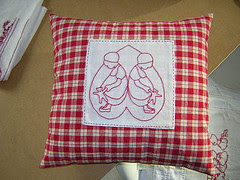
~ View the accomplishments of Redwork in Germany. She is a regular contributor to the Flickr Embroidery Group and her embroidery will definitely motivate you to try Redwork yourself.
See the Flickr Embroidery Pool where I posted the square I made and post one of your own!


A few weeks ago, Jenny Hart started a thread on Craftster asking every one to describe their ideal tea towel. Behold, the birth of the Sublime Stitching Tea Towel Tour! 10 participants signed up faster than a lightning flash and agreed to stitch the towel within 2 days and mail it on to the next stitcher... These lucky ducks also got a free pattern set from Jenny!

The tea towel has already made the rounds of numerous stitchers, including 3 Flickr embroiderers, IamSusie, Sarahland, and Carol, who was apparently in a rick-racky mood. :) Wanna see what the towel looks like now? Check it out! This a great way to get acquainted with all those talented Craftster embroiderers!
Hi, I'm floresita, editor of Feeling Stitchy. I'm an avid stitcher, knitter, and crafter. You can see more of my stitching on Instagram and my blog. My vintage transfer collection is on Vintage Transfer Finds.
Feel free to email me with any ideas for the blog!

The Egyptians were doing it. The Chinese mastered it. And your grandmother probably did too. Are you embellishing your clothes with stitches? Embroidered clothes have been around since the beginning of history and were once considered a sign of wealth. Today it is all about aesthetics and making a piece of clothing unique.

Throughout history, embroidered clothing has undergone many changes and is now filling our shopping malls, boutiques, and adorning couture fashion. With the increased interest in the needle arts, many of us are now embroidering our own clothing. All you need to do is look at the flickr embroidery group and you will see many women transforming an ordinary tank top into something very distinctive. There are many places to seek inspiration for altering your clothes, such as walking through shops, flipping through fashion magazines, and looking at embroidery patterns.

With spring here and warmer weather approaching, you might be looking to uplift your wardrobe. Check out anthropologie which has dedicated a section of their website to all things embroidered, including this sweet "bohio smock."
Here are some tips for embroidering clothes:
1. Use a stabilizer which adds support and eliminates sagging or pulled stitches. This is especially helpful when working on t-shirts or fabric with a lot of stretch.
* Sulky has a whole line of wonderful stabilizers.
2. Use an embroidery hoop that is sized to the area of fabric you are working. For example, if you are working on a neckline or sleeve use a very small hoop.
3. Don't feel like you need to do small, detailed work around necklines. You can use the back of a shirt and embroider a fabulous motif. This was very popular in the 70's ranging from the very sweet to the completely rock-n-roll!
4. Start with an item of clothing you found on sale or already have in your closet so there will be no tears or curses if you mess up.
5. Have fun and post your shirt, skirt, hat, or whatever on the Flickr Embroidery Pool.