Showing posts with label Arraiolos. Show all posts

January 3, 2013

Stitches with Portuguese Soul - 2012

Olá! In the beginning of this new year I thought of reviewing "stitches with Portuguese soul, my participation here in feeling stitchy... It has been such an incredible experience...

I loved to know that so many of you already visited Portugal (and loved it...), that others still care for the strong relationship their families have with this country, that some knew Portuguese embroidery, and even others that have never heard about our "little spot planted by the seashore” are generous and kind enough to read me each week.
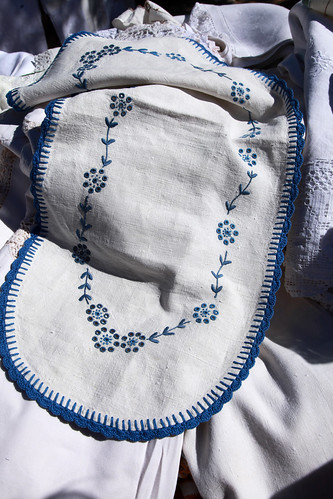
Vintage Stitches
Estremoz Flea Market, photo by ZPmoreira
We've started our journey with a very beautiful book, the first from Anchor's book series, Traditional Embroidery of Portugal... Do you remember?

I've been learning a lot... For this year's posts I will never forget the groups of women embroidering rugs sitting outside, in Arraiolos; the beauty of "Pauliteiros de Miranda" costumes beautifully decorated with picado; the young girls from Nisa that began working at early ages on their bridal trousseau and how their work helped them to begin a new life; how a treasure kept in a chest changed so many lives in Castelo Branco; how the natural beauty of the island inspired the first embroiderers from Madeira and the exuberance of these embroideries conquered the all world some years later; how embroidery can be a men's story, too as in Póvoa de Varzim; how a piece of embroidery can be a love letter as in Portuguese fiancé kerchiefs; and how a woman in difficult times was able to innovate by helping to create what we nowadays know as Viana do Castelo Embroidery.
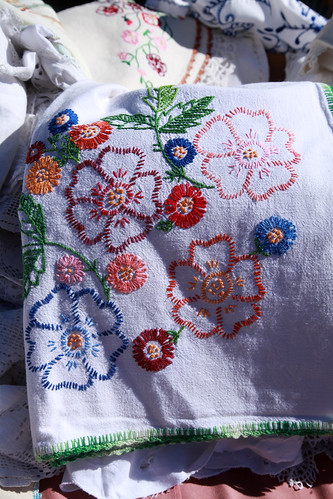


Vintage Stitches
Estremoz Flea Market, photo by ZPmoreira

I've also tried to show you some of my projects... embroidered necklaceembroidered card stock bookmarksembroidered notebooksbook cover tutorialChristmas lacing cardsChristmas memories notebook


And there is still so much to know... I will not forget to talk about regional embroidery from Caldas da Raínha, Tibaldinho, Guimarães, Lixa and Azores... I promise! And I'll bring in Portuguese cross stitch, too...


I also would love to show some more recent trends... And I'll begin doing it next week, showing the work of some new (not from old times...) embroiderers... 
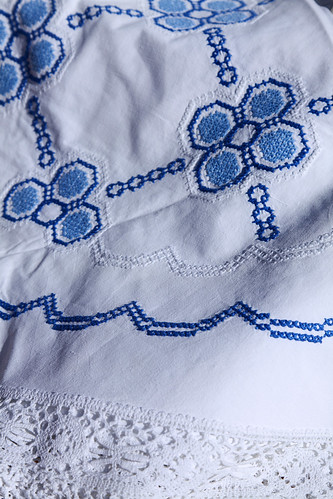


Vintage Stitches
Estremoz Flea Market, photo by ZPmoreira

I have to confess mixed feelings... I'm so happy because I know better Portuguese Embroidery and how in the past Portuguese people always felt so "stitchy" :). But at the same time, while trying to find some new embroiderers, I discovered that their number could be counted by the fingers of my both hands (maybe only one...), at least those that show their work in the web. Embroidery is still an industry, like in Viana do Castelo and Madeira... But other arts & crafts, not so traditional in Portugal, are taking the place of embroidery... And I feel said about it it... I truly would love to do something to change it. So... Here come my new year's goal!!


This year I would like to prove (above all to Portuguese people) that Portugal is a living museum of embroidery. In each home  there are so many treasures that we must show and be proud of. I believe that will inspire new embroiderers...


My motto for 2013 will be embroideries out of the drawers!!! I will challenge all of those who have Portuguese pieces of embroidery to show them and take pictures... If you are one of those lucky ones, are you going to join me???


But you can help me anyway... Tell me about what you liked (or disliked) the most in this journey... Or what would you like to read about in the time left... Can I count on your help??
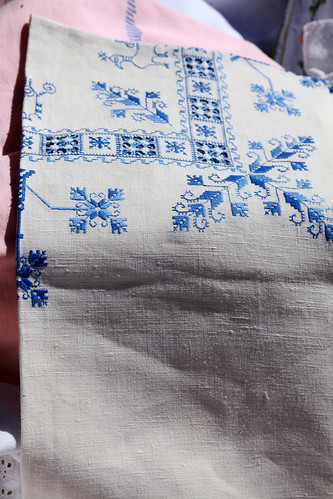


Vintage Stitches
Estremoz Flea Market, photo by ZPmoreira


I can't forget to thank you for being with me in this trip, for your kind comments and your emails... And the interest shown every week in the stitches coming from our small country...

And here you have some Portuguese words I've been talking about...  saudadelivro, obrigadajaponeiralençovestidobordadeiraenxovalbelezasentido artísticomãefilha, tapetestapeçariaorgulhosainspiradorpaicolchasmontepãotaleigocamisolaspicadoFeliz Natalamor

July 19, 2012

Arraiolos needlewomen - connecting the house to the street

Olá! This week I'm going to talk about the needlewomen that create Arraiolos Carpets and Tapestries, one of the most famous embroidery traditions in Portugal. Its name comes from a very beautiful village in Alentejo, a region in the south of Portugal. And I could not find a better way to begin than translating a piece of a school work done by very small children that live there, in Arraiolos. I'll try to remain faithful to their words...

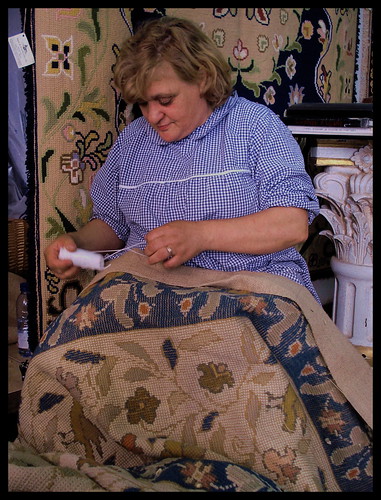
"An embroiderer is the woman who embroiders rugs and must have patience and ingenuity. The visitor that comes to Arraiolos will easily find women and girls embroidering rugs at the doorstep of their homes. In ancient times, embroiderers copied directly from the patterns that were hanging on the wall ahead. Nowadays they copy down the pattern from a graph paper. There would be no Arraiolos Carpets without embroiderers. A resourceful and experienced embroiderer needs 15 days to complete one square meter."(1)

Drawing representing a needlewoman from Arraiolos made by the authors of the text

Arraiolos is type of counted thread embroidery using wool thread on fabric which can be jute or linen. The world-famous Arraiolos Stitch is a long-armed cross-stitch, the basis of the technique used in making these carpets, but it was not born there. The first documentation on the use of this technique comes from the 12th century in Spain, while the first reference to a rug made in Arraiolos dates to 1598. Only later this stitch gained the "Arraiolos" designation but nowadays it is known as that almost everywhere.

And history tells us more... The first embroiderers of these rugs were middle class women, living in the urban area of Arraiolos for whom embroidery was a domestic and not commercial activity.

Arraiolos-Portugal
Needlewoman from Arraiolos, photo by Cida Garcia

But how is that we find such an impressive craft treasure from long long ago in a small village, far from the capital? History explains it...
With the expelling of Jews and Moors from Spain by the Catholic kings and the beginning of the exodus, along with the temporary settlement of these peoples in Portugal, until 1511 -- when Manuel I forced them to resume their journey to the north of Africa -- various people decided to settle down in Arraiolos, due to the warm welcome, the abundance of herds, of excellent wool and the diversity of plants, indispensable to the dying and making of canvas, together with the sensitivity and work capacity of the villagers. (2)


ARRAIOLOS, BORDADOS
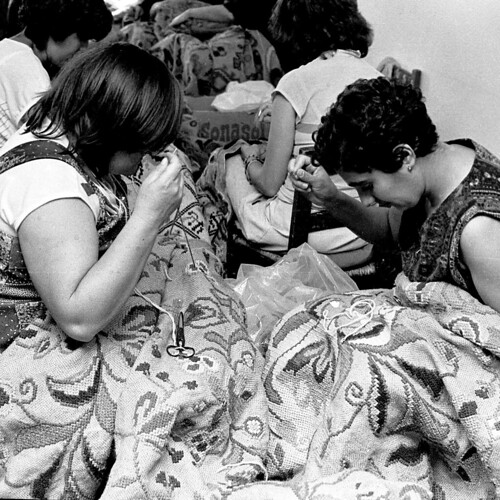
Women embroidering, photo by Fernando Ricardo

Documents also show that in addition to the local importance of wool production, there was an intensive textile activity with the presence of many professionals needed to the rug's execution. It was known that carpets were made by Jews and Moors in Lisbon before they left the town. So it is plausible that the coincidence of experienced carpet makers joining the materials and textile professionals gave birth to this treasure of Portuguese culture.

However...In the end of the 19th century, the making of Arraiolos rugs practically did not exist... With the beginning of the 20th century, the "rebirth" of the Arraiolos rugs occurs -- a group of women from the village recreated models, based on those which, in different eras, had been unsurpassed examples of the Arraiolos rugs, thus creating a new era.(2)


"O tapete está na rua"
An Arraiolos Carpet in the street, photo by Rosa dos Ventos

Recently in Arraiolos a monument was built paying homage to Arraiolos' needlewomen. The author of the monument justifies it:
"(the embroiderers) patiently dominated the motifs of birds, flowers, medallions, geometrical bars, developing a decorative art that settled in the daily life of population. Carpets are intimately related to the way of life and sociability of Arraiolos providing unique moments of familiarity: we see groups of women sitting in the shade of the houses and walls, in the long and bright days, patiently embroidering rugs then installed in the interior of homes. The needlewomen are, still today, the foundation of a cultural circuit that connects the house to the street and Arraiolos to the rest of the world."

Embroiderers in the streets of Arraiolos, photo from here

Let me end with a legend, the Forever Bride, which show us how rugs are so deeply rooted in local traditions.
There was a young damsel who was engaged at the time when there was ongoing wars between the Christians and the Moors. As the village was attacked, her betrothed had to leave for combat. It was a long time before the groom returned and grieving at the loss of youth it took him a long time to resurface. When the bride eventually showed up for the wedding, she covered herself with a rug to hide the marks of time. (3)

Arraiolos
Arraiolos Carpets in the streets of the village, photo by Rosa dos Ventos
Now talking about new Portuguese words... Tapete means rug and tapeçaria means tapestry...

(This "story" on Arraiolos Carpets History is not closed. Other theories have been proposed and new evidence were discovered - here and here you'll find more information.)
SITE DESIGN BY RYLEE BLAKE DESIGNS