Showing posts with label embroiderer. Show all posts

January 16, 2014

Beautiful key chains from Portugal

Olá! Today I'll continue on last week's Portuguese blog, cesto da roupa, from the hands of Isabel Jardim. And this week I tried to learn a little bit more about Isabel's relationship with embroidery...

Like many of you (I believe...), Isabel's first stitches were at school, embroidering perforated cards.
Her love for embroidery is an old love. And for a long time she embroidered and sold many, many commemorative (birthday, marriage...) cross stitch works.

Winter look...
She likes to see motifs gaining color and volume. Often she does not use a pattern, especially with floral motifs - Isabel embroiders freely, until the whole piece looks balanced and harmonious... and she certainly has a gift for creating charming flowers!

In blue...

As the photos of last week show, she believes that a small embroidered detail makes a piece of work really unique!

Pastel...
I decided to keep these photos for last, since I'm completely crazy about them... These key chains won my attention when I saw them in a craft fair and I decided that I had to show them here...

So delicate...

I was not expecting it to be so difficult to choose the photos... I like each and every one of them...

Red, red, red...

Green and pink...

Do you know what Isabel's family name, Jardim, means in Portuguese? It means "Garden"... and that's what this post looks like!!!

July 19, 2012

Arraiolos needlewomen - connecting the house to the street

Olá! This week I'm going to talk about the needlewomen that create Arraiolos Carpets and Tapestries, one of the most famous embroidery traditions in Portugal. Its name comes from a very beautiful village in Alentejo, a region in the south of Portugal. And I could not find a better way to begin than translating a piece of a school work done by very small children that live there, in Arraiolos. I'll try to remain faithful to their words...

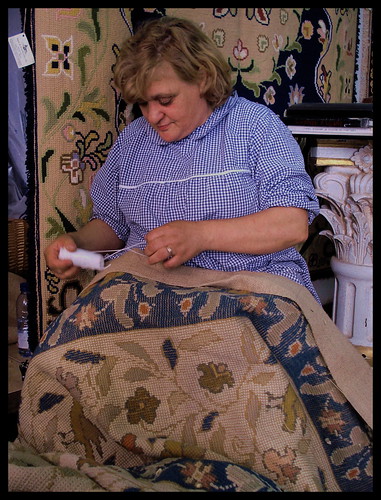
"An embroiderer is the woman who embroiders rugs and must have patience and ingenuity. The visitor that comes to Arraiolos will easily find women and girls embroidering rugs at the doorstep of their homes. In ancient times, embroiderers copied directly from the patterns that were hanging on the wall ahead. Nowadays they copy down the pattern from a graph paper. There would be no Arraiolos Carpets without embroiderers. A resourceful and experienced embroiderer needs 15 days to complete one square meter."(1)

Drawing representing a needlewoman from Arraiolos made by the authors of the text

Arraiolos is type of counted thread embroidery using wool thread on fabric which can be jute or linen. The world-famous Arraiolos Stitch is a long-armed cross-stitch, the basis of the technique used in making these carpets, but it was not born there. The first documentation on the use of this technique comes from the 12th century in Spain, while the first reference to a rug made in Arraiolos dates to 1598. Only later this stitch gained the "Arraiolos" designation but nowadays it is known as that almost everywhere.

And history tells us more... The first embroiderers of these rugs were middle class women, living in the urban area of Arraiolos for whom embroidery was a domestic and not commercial activity.

Arraiolos-Portugal
Needlewoman from Arraiolos, photo by Cida Garcia

But how is that we find such an impressive craft treasure from long long ago in a small village, far from the capital? History explains it...
With the expelling of Jews and Moors from Spain by the Catholic kings and the beginning of the exodus, along with the temporary settlement of these peoples in Portugal, until 1511 -- when Manuel I forced them to resume their journey to the north of Africa -- various people decided to settle down in Arraiolos, due to the warm welcome, the abundance of herds, of excellent wool and the diversity of plants, indispensable to the dying and making of canvas, together with the sensitivity and work capacity of the villagers. (2)


ARRAIOLOS, BORDADOS
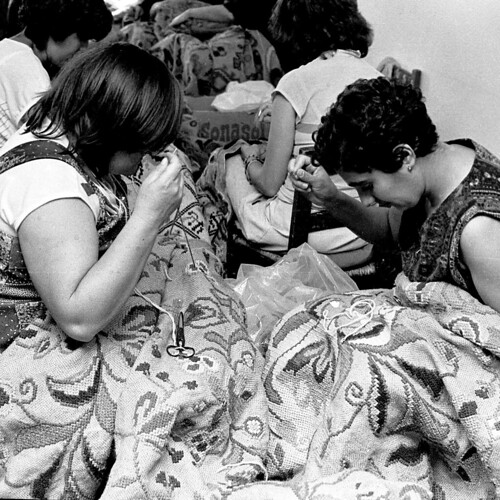
Women embroidering, photo by Fernando Ricardo

Documents also show that in addition to the local importance of wool production, there was an intensive textile activity with the presence of many professionals needed to the rug's execution. It was known that carpets were made by Jews and Moors in Lisbon before they left the town. So it is plausible that the coincidence of experienced carpet makers joining the materials and textile professionals gave birth to this treasure of Portuguese culture.

However...In the end of the 19th century, the making of Arraiolos rugs practically did not exist... With the beginning of the 20th century, the "rebirth" of the Arraiolos rugs occurs -- a group of women from the village recreated models, based on those which, in different eras, had been unsurpassed examples of the Arraiolos rugs, thus creating a new era.(2)


"O tapete está na rua"
An Arraiolos Carpet in the street, photo by Rosa dos Ventos

Recently in Arraiolos a monument was built paying homage to Arraiolos' needlewomen. The author of the monument justifies it:
"(the embroiderers) patiently dominated the motifs of birds, flowers, medallions, geometrical bars, developing a decorative art that settled in the daily life of population. Carpets are intimately related to the way of life and sociability of Arraiolos providing unique moments of familiarity: we see groups of women sitting in the shade of the houses and walls, in the long and bright days, patiently embroidering rugs then installed in the interior of homes. The needlewomen are, still today, the foundation of a cultural circuit that connects the house to the street and Arraiolos to the rest of the world."

Embroiderers in the streets of Arraiolos, photo from here

Let me end with a legend, the Forever Bride, which show us how rugs are so deeply rooted in local traditions.
There was a young damsel who was engaged at the time when there was ongoing wars between the Christians and the Moors. As the village was attacked, her betrothed had to leave for combat. It was a long time before the groom returned and grieving at the loss of youth it took him a long time to resurface. When the bride eventually showed up for the wedding, she covered herself with a rug to hide the marks of time. (3)

Arraiolos
Arraiolos Carpets in the streets of the village, photo by Rosa dos Ventos
Now talking about new Portuguese words... Tapete means rug and tapeçaria means tapestry...

(This "story" on Arraiolos Carpets History is not closed. Other theories have been proposed and new evidence were discovered - here and here you'll find more information.)

June 21, 2012

Women in Viana do Castelo Embroidery

Olá! This week I'll be talking about embroiderers coming from the North of Portugal.
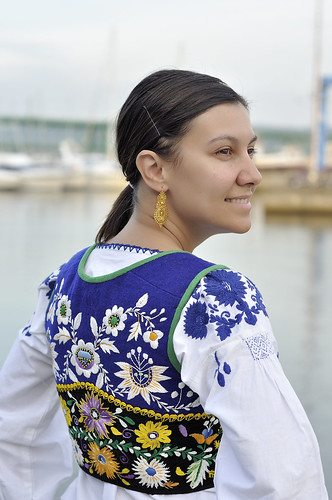
Viana do Castelo embroidery (named after a town in the Portuguese Minho region) as we know it was born in the beginning of the XXth century. Before that there was a tradition of beautifully embroidered women's costumes worked by peasant needlewomen.

Fabíola
Traditional Viana's Costume, by Rui Silva
The peasant women from Minho created their own patterns, mainly inspired by nature, by what surrounded them and captured their attention, not to mention love, whose symbol, the heart, they never forgot. Although inspired by what surrounded them, they assimilated and reproduceded it in their own way, with art, without hesitation, with determination, and based on tradition.

In 1917, Gemeniana de Abreu e Lima gathered some of those embroideries and adapted the patterns used to suit the home, with main focus on the tablecloths, aprons, curtains… She organized an exhibition showing these peasant embroideries that was a true success and many attribute this moment to the birth of modern Viana do Castelo embroidery.

Gemeniana de Abreu e Lima, in 1917. Photo from CEBVC
The genius and generosity of this woman were crucial. She recognized the beauty and artistic sense of peasant embroideries and brought them to an urban market, providing these women not only the recognition for their work but also attributing an economic meaning to it.

These were times of war, the First World War, and many women were alone with their children while the men were fighting. And Germeniana had this in mind when she began this work that soon obtained broad recognition even abroad. Some years later there was already a vigorous embroidery industry.

The embroidery of Viana became a source of income for many families in the rural areas – and in urban areas too. The companies distributed the pieces and threads by embroiderers, usually women living in villages near the city of Viana do Castelo. The embroiderers executed the embroideries in their own homes, occupying the remaining time from their other activities, often working for different companies. When the work was done, the embroiderers went to town, where they delivered to those who ordered.

In her isolation, the Minho woman transmitted joy, love and feeling to personal and daily use objects, like the costumes that characterize this region or the cloths that cover their tables. These peasant women beautifully combined embroidery as an earning source and the pleasure of creating art, in the long evenings of the village, in the sunny days of spring sunshine or in the soothing shadows of warm summer afternoons.
Old postcard representing Viana embroiderers, from here
Endowed with a true artistic sense, they show it chiefly in the way they decorate their gala costumes… The Minho needlewomen have their inventive powers so well developed that they prepare their own designs. At the most, they keep in a box small paper patterns of all the traditional motifs such as hearts, crosses, keys urns, clover leaves, ivy and oak, flowers of various shapes, birds, etc. and even the shuttle of their hand loom serves as an ornamental motif. (1)


I loved getting to know this woman that in a time of crisis was able to bring to light the amazing ability of other women and create something new and beautiful. And I also loved to know how peasant women adapted their art and creativity to new demands... I believe that nowadays we would call it "innovation"...
These days we are facing a severe crisis in Portugal and we need many more of both of these kinds of women...  I hope this may be an inspiration to them!!

I was almost forgetting our Portuguese class... Today it's difficult to choose the words... I'll choose the words that I read more often to characterize the work of these women: beauty and artistic sense... "beleza" and "sentido artístico"...


* I wrote this post after reading the books I've already talked about in my other posts, here and here and this document about Viana do Castelo embroidery.


June 14, 2012

Nisa embroiderers and the "enxoval"

Olá! This week I begin talking about Portuguese regional embroiderers with Nisa needlewomen. Nisa embroidery is not one of the most famous in Portugal but is one of my favorites. You can’t imagine how diversified is the work coming from the hands of these women. Embroidery on linen, felt embroidery (the skirts), embroidered shawls, alinhavados and even more... I’ll show you one of these weeks…

I collected some descriptions of Nisa needlewomen and as far as I understood until the second half of XXth century they were still faithful to reality... Since then the role of Portuguese women in society changed a lot and the "enxoval" is no longer an "embroidery inspiration" to Nisa women - "mulheres de Nisa" in Portuguese...

Nisa, a small town nestled in Portugal’s interior, had a unique expression in Portuguese culture, where traditionally, girls from the age of six, would make embroideries working for years to create a bridal trousseau, which would then be sold on the eve of their wedding. With the money made from the sale, the bride would purchase, through her own means, a house for the newlywed couple. (1)

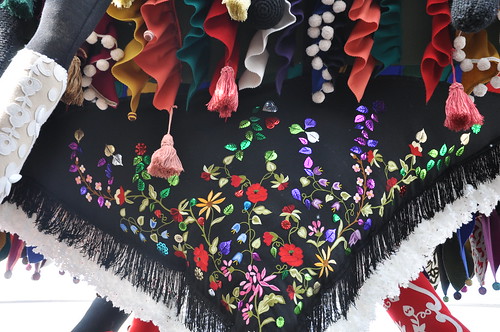
Nisa embroiderer working on alinhavados and wearing traditional costumes hand embroidered, in Museu do Bordado e do Barro
The women of the Nisa districts cultivate the art of perfection. “Cloth sprays” they are called by the marriageable girls who, in the expectation of a future bridegroom, begin early to prepare towels and sheets that later will form a magnificent part of their bridal linen and, on some distant wedding day, will be displayed in all its glory to admitting relations and friends. (2)

Hands of Nisa embroiderer, alinhavados, in Museu do Bordado do Barro
The bride’s bed, called “solemn bed”, was usually adorned with quilts, blankets, sheets and towels, most of the times made by the bride herself. These were something to be proud of, a joy for anyone who visited, and stirred naive jealousy among marriageable young girls. (3)

It seems that many many years ago Nisa embroiderers were inspired by the idea of one day getting married and having a marvelous trousseau that they could sell or keep… In Portuguese we say “enxoval” - a collection of handsewn housewear pieces to be used after one’s wedding (3)…

This tradition does not go on anymore… And Nisa embroiderers are becoming less and less…
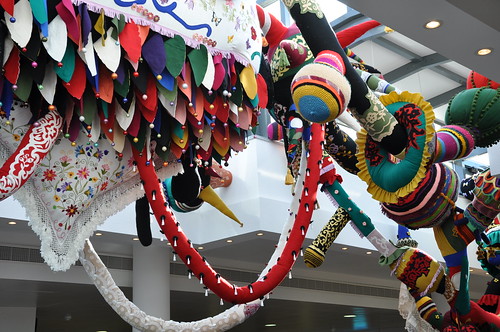
However, recently, a famous Portuguese contemporary artist helped give new life to Nisa Embroidery. Joana Vasconcelos roots a great part of her work in Portuguese culture, doing so in an incredibly creative and surprising way… She works with Portuguese artisans and their productions are used in her art. That’s what happened with Nisa embroideries.

Recalling the “enxoval” tradition she has created Enxoval Valquíria - Valkyrie Trousseau, a sculpture 16 meters in length, in collaboration with textile artisans from Nisa. All of the diversity of Nisa embroidery is represented…
Here you'll find a great video on this long sculpture... No difficulties with Portuguese :)

Valquíria Enxoval (de Joana Vasconcelos)

Valquíria Enxoval (de Joana Vasconcelos)
"Enxoval Valquiria" with Nisa embroidery by Joana Vasconcelos, acrib photos
Next Tuesday, Joana Vasconcelos will be the first woman and the youngest contemporary artist to exhibit in Versailles (Paris). We are so proud!!

I end with a beautiful video on Nisa embroiderers and Joana de Vasconcelos - only 2 minutes... An excerpt from a documentary I would love to watch... I do recommend it!!!! No problem with Portuguese, it has English subtitles...

May 31, 2012

Do you feel like an embroiderer?

Olá! Do you consider yourself an embroiderer - "uma bordadeira"? Do you know that embroiderers are unique creatures? Today I’ll talk about that…
Some months ago I bought a wonderful Portuguese written book, “Bordados e Rendas de Portugal” - "Embroideries and Laces of Portugal", first edited in 1956. The author is Calvet de Magalhães, a great pedagogue. I will refer to this book often in my upcoming posts. But today I would like to share with you what the author writes about the “embroideress’s profession.” I love his words! It was a big challenge translating it as they are written in “an old time” Portuguese but I believe its beauty comes from that, too… Accept it as a “free translation”…

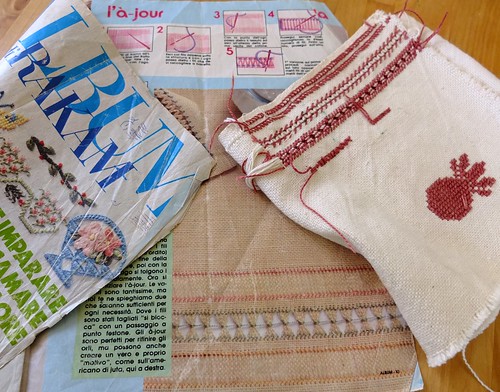
I illustrate these words with my own pieces of embroidery. My first stitches, in 1984, a cross-stitch work following a Rakam pattern, concluded in 1992, and my first pattern designed for agulha não pica.

My first embroidery stitches...We were in 1984!!
My first embroidery stitches many years ago... A recent photo of the sample and magazine I kept.

I begin near the end where the author describes some physical impediments for someone to become a (professional) embroiderer. So curious... For this profession are restricted people whose lungs are not in good condition or who have pronounced anemia; those who suffer of the digestive tract or have predisposition for these disorders (constipation, hemorrhoids, etc.); and those who have nervous disorders, cardiac defects, deviations from the spine, severe myopia or transpire too much of the hands...

Now I suggest that you read this carefully, these are beautiful and wise words...

... An embroideress must have special skills: a refined artistic sensibility and a calm, persistent and patient temperament. She must love the work she executes. The embroideress cherishes and is legitimately proud of her work, she does not get impatient nor exasperated by the difficulties of execution. She is not easily satisfied and strives to always do better.

Those who dedicate themselves to embroidery fall into three groups. In the first group are included those embroideresses who take their job seriously, are willing to start at the beginning and make their own designs. These embroideresses believe their pieces of embroidery can be a work of art and they will spare no time nor work until it really happens.

Into the second group will fall the embroideresses who are willing to devote some time to embroidery, who like to work in the evening and are always ready to devote the necessary time to learn the stitches, although the word "design" terrifies them. They are generally prepared to accept without question any pattern bought in a vulgar store, thinking that the design will be infinitely better than what they could do.


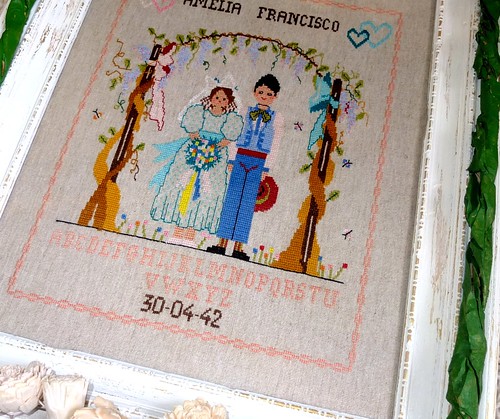
Wedding cross stitch pattern
A Rakam's pattern embroidered by me and offered to my grandparents at their gold wedding anniversary

To the third group belong those who buy a printed fabric (and with the floss already chosen) at a luxury store, bring it home to work on it from time to time, in their spare time during a year or two, and eventually get bored and take it back to the shop for them to finish.

The embroidereress of the first group is routed to be successful, the second by persuasion and encouragement may be willing to take risks and start from the beginning, the third, whom we would not dare to qualify as a serious embroidereress, nothing prevents her from reaching the first group, if she is willing to sacrifice the time and effort required...

Do you know why I empathize with these words? It’s so clear that they were written by someone who has a teacher’s soul… Someone who is tremendously demanding but believes that by sacrificing time and effort anyone can become a superb embroiderer. I do believe in that too…

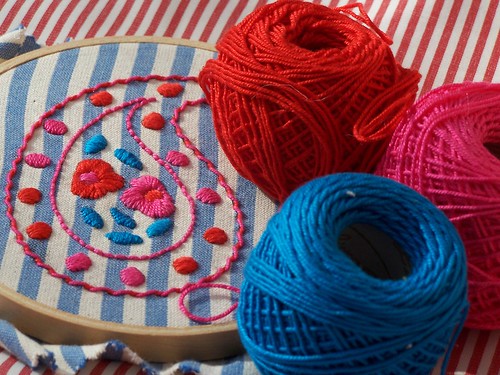
Paisley pattern - agulha não pica
My first pattern for agulha não pica and improbable color choice... Photo chosen by Faceook friends/fans

Do you have a calm, persistent and patient temperament? Which group do you belong to? I would love to read your thoughts on this…
SITE DESIGN BY RYLEE BLAKE DESIGNS