Showing posts with label Viana do Castelo embroidery. Show all posts

January 30, 2014

From Viana with love and cork

Olá! Today I'm continuing from last week's post showing the incredible work of Teresa, from Artesaté, that recreates the Portuguese traditional embroidery of Viana do Castelo, from the Minho region.

Tradition says that the embroiderer must use a cotton thread in blue, white and red. And Teresa uses blue, white and red... but the shining of Viana's jewelry inspired her to use gold, too..

Tradition says that the embroiderer must use cotton and linen fabrics... but the need of modernizing her work inspired Teresa to use felt and, lately, cork fabric, too...

Tradition says that the embroiderer must use hearts, japoneiras, oak leaves and clover leaves as motifs (among others)... but lately the embroiderers have forgotten the leaves... and Teresa, inspired by her wish of being faithful to the genuineness of Viana's embroidery and her permanent desire of knowing more and more, recovered the clover and oak leaves in her stitching, too.


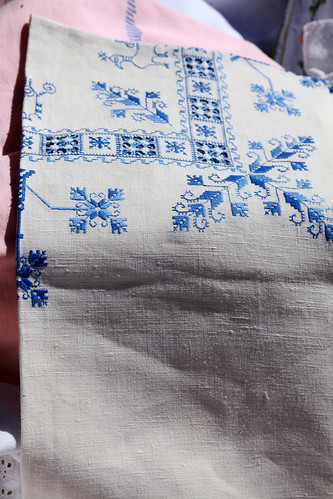
Blue, red and white, the most traditional colors in Viana do Castelo Embroidery.


Teresa argues that the impressive presence of gold jewelry in her home city, Viana do Castelo, was the main influence on her choice of using metallic threads in her embroidery.

Born 100 years ago, the "modern" Embroidery of Viana do Castelo, suited for home linen, is now subject to a certification process that requires the respect of some rules which dictate the non use of golden thread. However, more than 100 years ago, the embroidery tradition was deeply rooted in this region, with a widespread use of wool yarn to embellish women's costumes: skirtspouches and waistcoats. As you may confirm if you follow the links, this embroidery was profuse in the use of color, including metallic threads. Today these threads are not common, with the exception of their use in embroidered boxes, very popular in Viana do Castelo.


In gold, inspired by the rich jewelry.

The choice of the clover and oak leaves as well as the use of cork are the latest innovations in Teresa's work. And the photos I bring are very recent...

In the traditional embroidery from Viana do Castelo, clovers were popular patterns. Seventy or eighty years ago there were three and four-leaf clovers and their size varied greatly, but nowadays the clovers are rare and very small. In the past, the patterns inspired by nature were stylized by the embroiderers from the Minho region. Driven by emotion, while creating a clover, the embroiderer could not resist to draw it by the joining of three or more hearts, reinventing once and again the love pattern. And that's what we find on the last embroidered heart by Artesaté, that uses this lately recovered motif and the blue from Viana's ocean.


At the top the three-leaf clover, joining three hearts

It may sound unexpected but Teresa feels that Viana's embroidery and cork, being both famous symbols of Portugal, make a unique combination of textures and colors. It's natural that her words about the joy of embroidering on cork fabric may be overstated due to the excitement of a new love, but still they are worth being translated:

"It's a slow job that needs more attention. Stitches must be perfect at the first attempt, there is no space for errors once if you need to undo your stitching the cork fabric will be damaged. But the final work is special, more perfect, of a smoother texture to the touch and more rustic in appearance, which fits in perfectly with the tradition that I intend to transmit. The smell of cork fabric is one of the things that pleases and fascinates me the most, it spreads through the office making me feel that I'm working with nature and tradition."


In white, like tradition dictates... And recovering the oak leaf (at the top) forgotten in recent years.

Knowing how Teresa works, I'm already curious to see where this unique combination of tradition, innovation and love for Viana will take her...

January 23, 2014

From Viana with love

Olá! Today I bring you something very special... Definitely this is a Portuguese story... And as we would say in Portuguese: a história de uma mulher do Norte - "the story of a woman from the North"...

Sometime ago I told you how the Traditional Embroidery of Viana do Castelo was so intricately interwoven with the story of many women. And how the birth of what we recognize today as this regional embroidery helped so many of them find a new way of life - that is still deeply rooted in the culture and the traditions of the North of Portugal.


Teresa embroidering and wearing the domingar costume (to be used on Sundays)

The story of Teresa, that I bring you today, bears some resemblance to the one I told you before. This is also a love story for Viana and again a proof that with courage and talent we can change our lives.


An original Christmas crib winner of a contest promoted by the municipality of Viana do Castelo

Teresa was born in Viana do Castelo and the traditions, the culture and the folklore of this region were always present in her daily life since she was a little child. As happens with other women and men from this city, Teresa waited, and still waits, all year for the festivities dedicated to Our Lady of Agony, Romaria da Senhora D’Agonia, one of the most rich and genuine ethno-folklore festivals of our country. These are special days, when Teresa proudly wears the folk costume made by her own hands and holds the famous gold jewelry while the colorful folk dance groups musically enliven the ambiance and invite everybody to dance (be sure to follow this last link and watch how common people follow the dancers and fully enjoy it).


An embroidered brooch inspired by the skirts of folk costumes

Embroidery came into her life, by the hands of her mother, so naturally as all the other cultural traditions from Viana did. Inspired by the lively colors of the costumes - the bright red, the shining gold - and by the embroidery that decorated the linens of the house where she was born, Teresa discovered this new way of living. After some years teaching arts and technology to children she decided to devote her life to reinvent Traditional Embroidery of Viana do Castelo creating embroidered accessories that adorn our days: key holders, brooches, small cushions, beautiful frames, wedding favors...


Details of Teresa's stitching

Viana é amor, a popular saying that means "Viana is love", justifies the massive presence of Viana's heart in the crafts and culture of this city. That special heart is everywhere... In the noble art of filigree, in gold jewelry works, in embroidered table linen. For many, the heart of Viana even became one of the symbols of Portugal. Teresa elected the Viana's heart as the symbol of her work - Artesatébecause in Viana, quem gosta vem, quem ama fica - the one who likes comes, the one who loves stays.


Viana's heart - the symbol of Artesaté's work


Teresa feels that her life is unique and special because she was born there, in that special place, where the river meets the sea under the eyes of the hill of Santa Luzia. And Teresa, believe me, has developed the art of bringing to each piece of her work this uniqueness that only someone who belongs to a special place may have... Each stitch tells a story of joy, color and love...


Viana in gold

"Viana is more than a city, it's a way of living... a way of being that lies deep in the soul and the blood of those who were born there..." These are Teresa's words and she reinforces; "That's what I am".

Note: While writing this post I was thinking about how our culture and traditions are such a supreme form of richness that we must preserve for our own good and for the future happiness of our children. Portuguese history and the story of so many Portuguese women are the living proof of this...

June 27, 2013

Poetry and embroidery

Olá! Portugal is not only a country of embroiderers... It is also well known for being a country of poets... And I believe that embroidery and poetry make a unique combination...

This week I leave you with my stitches, using a pattern from agulha não pica inspired by Viana do Castelo Regional embroidery - a beautiful flower known as "japoneira", and the words (in Portuguese) of Fernando Pessoa - one of the most famous Portuguese poets.

In Portuguese the words sound very popular and sweet. In English it does not sound so beautiful, it is very difficult to translate such graceful words...

I dedicate it to each you...

De regresso com novidades... Coming back
Japoneira, my photo
 
Tome lá, minha menina,  
O ramalhete que fiz. 
Cada flor é pequenina, 
Mas tudo junto é feliz. 
                  Fernando Pessoa

Take it, my little girl, 
This bouquet I made.  
Each flower is tiny, 
But joyful when together. 
                  Fernando Pessoa

January 3, 2013

Stitches with Portuguese Soul - 2012

Olá! In the beginning of this new year I thought of reviewing "stitches with Portuguese soul, my participation here in feeling stitchy... It has been such an incredible experience...

I loved to know that so many of you already visited Portugal (and loved it...), that others still care for the strong relationship their families have with this country, that some knew Portuguese embroidery, and even others that have never heard about our "little spot planted by the seashore” are generous and kind enough to read me each week.

Vintage Stitches
Estremoz Flea Market, photo by ZPmoreira
We've started our journey with a very beautiful book, the first from Anchor's book series, Traditional Embroidery of Portugal... Do you remember?

I've been learning a lot... For this year's posts I will never forget the groups of women embroidering rugs sitting outside, in Arraiolos; the beauty of "Pauliteiros de Miranda" costumes beautifully decorated with picado; the young girls from Nisa that began working at early ages on their bridal trousseau and how their work helped them to begin a new life; how a treasure kept in a chest changed so many lives in Castelo Branco; how the natural beauty of the island inspired the first embroiderers from Madeira and the exuberance of these embroideries conquered the all world some years later; how embroidery can be a men's story, too as in Póvoa de Varzim; how a piece of embroidery can be a love letter as in Portuguese fiancé kerchiefs; and how a woman in difficult times was able to innovate by helping to create what we nowadays know as Viana do Castelo Embroidery.


Vintage Stitches
Estremoz Flea Market, photo by ZPmoreira

I've also tried to show you some of my projects... embroidered necklaceembroidered card stock bookmarksembroidered notebooksbook cover tutorialChristmas lacing cardsChristmas memories notebook


And there is still so much to know... I will not forget to talk about regional embroidery from Caldas da Raínha, Tibaldinho, Guimarães, Lixa and Azores... I promise! And I'll bring in Portuguese cross stitch, too...


I also would love to show some more recent trends... And I'll begin doing it next week, showing the work of some new (not from old times...) embroiderers... 


Vintage Stitches
Estremoz Flea Market, photo by ZPmoreira

I have to confess mixed feelings... I'm so happy because I know better Portuguese Embroidery and how in the past Portuguese people always felt so "stitchy" :). But at the same time, while trying to find some new embroiderers, I discovered that their number could be counted by the fingers of my both hands (maybe only one...), at least those that show their work in the web. Embroidery is still an industry, like in Viana do Castelo and Madeira... But other arts & crafts, not so traditional in Portugal, are taking the place of embroidery... And I feel said about it it... I truly would love to do something to change it. So... Here come my new year's goal!!


This year I would like to prove (above all to Portuguese people) that Portugal is a living museum of embroidery. In each home  there are so many treasures that we must show and be proud of. I believe that will inspire new embroiderers...


My motto for 2013 will be embroideries out of the drawers!!! I will challenge all of those who have Portuguese pieces of embroidery to show them and take pictures... If you are one of those lucky ones, are you going to join me???


But you can help me anyway... Tell me about what you liked (or disliked) the most in this journey... Or what would you like to read about in the time left... Can I count on your help??


Vintage Stitches
Estremoz Flea Market, photo by ZPmoreira


I can't forget to thank you for being with me in this trip, for your kind comments and your emails... And the interest shown every week in the stitches coming from our small country...

And here you have some Portuguese words I've been talking about...  saudadelivro, obrigadajaponeiralençovestidobordadeiraenxovalbelezasentido artísticomãefilha, tapetestapeçariaorgulhosainspiradorpaicolchasmontepãotaleigocamisolaspicadoFeliz Natalamor

June 21, 2012

Women in Viana do Castelo Embroidery

Olá! This week I'll be talking about embroiderers coming from the North of Portugal.
Viana do Castelo embroidery (named after a town in the Portuguese Minho region) as we know it was born in the beginning of the XXth century. Before that there was a tradition of beautifully embroidered women's costumes worked by peasant needlewomen.

Fabíola
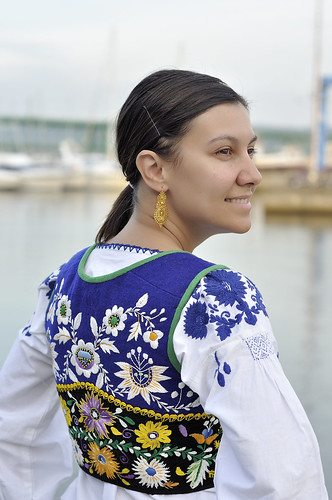
Traditional Viana's Costume, by Rui Silva
The peasant women from Minho created their own patterns, mainly inspired by nature, by what surrounded them and captured their attention, not to mention love, whose symbol, the heart, they never forgot. Although inspired by what surrounded them, they assimilated and reproduceded it in their own way, with art, without hesitation, with determination, and based on tradition.

In 1917, Gemeniana de Abreu e Lima gathered some of those embroideries and adapted the patterns used to suit the home, with main focus on the tablecloths, aprons, curtains… She organized an exhibition showing these peasant embroideries that was a true success and many attribute this moment to the birth of modern Viana do Castelo embroidery.

Gemeniana de Abreu e Lima, in 1917. Photo from CEBVC
The genius and generosity of this woman were crucial. She recognized the beauty and artistic sense of peasant embroideries and brought them to an urban market, providing these women not only the recognition for their work but also attributing an economic meaning to it.

These were times of war, the First World War, and many women were alone with their children while the men were fighting. And Germeniana had this in mind when she began this work that soon obtained broad recognition even abroad. Some years later there was already a vigorous embroidery industry.

The embroidery of Viana became a source of income for many families in the rural areas – and in urban areas too. The companies distributed the pieces and threads by embroiderers, usually women living in villages near the city of Viana do Castelo. The embroiderers executed the embroideries in their own homes, occupying the remaining time from their other activities, often working for different companies. When the work was done, the embroiderers went to town, where they delivered to those who ordered.

In her isolation, the Minho woman transmitted joy, love and feeling to personal and daily use objects, like the costumes that characterize this region or the cloths that cover their tables. These peasant women beautifully combined embroidery as an earning source and the pleasure of creating art, in the long evenings of the village, in the sunny days of spring sunshine or in the soothing shadows of warm summer afternoons.
Old postcard representing Viana embroiderers, from here
Endowed with a true artistic sense, they show it chiefly in the way they decorate their gala costumes… The Minho needlewomen have their inventive powers so well developed that they prepare their own designs. At the most, they keep in a box small paper patterns of all the traditional motifs such as hearts, crosses, keys urns, clover leaves, ivy and oak, flowers of various shapes, birds, etc. and even the shuttle of their hand loom serves as an ornamental motif. (1)


I loved getting to know this woman that in a time of crisis was able to bring to light the amazing ability of other women and create something new and beautiful. And I also loved to know how peasant women adapted their art and creativity to new demands... I believe that nowadays we would call it "innovation"...
These days we are facing a severe crisis in Portugal and we need many more of both of these kinds of women...  I hope this may be an inspiration to them!!

I was almost forgetting our Portuguese class... Today it's difficult to choose the words... I'll choose the words that I read more often to characterize the work of these women: beauty and artistic sense... "beleza" and "sentido artístico"...


* I wrote this post after reading the books I've already talked about in my other posts, here and here and this document about Viana do Castelo embroidery.


May 17, 2012

Japoneira - free pattern

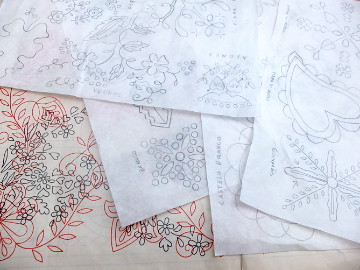
Traditional Portuguese embroidery patterns     
Design sheet and tracing paper, my photo
Olá! After reviewing the book "Traditional Embroidery of Portugal" I was amazed with the design sheets that were included in it. But believe me... What a big confusion! They are profusely filled with drawings which overlap each other and it becomes very difficult to identify and capture a single pattern. But I managed to do it and after some finishing touches I ended up with four sheets of tracing paper filled of marvelous patterns representing various types of traditional Portuguese embroidery. I'm feeling so rich!!! And I want to share my richness with you...

Japoneira - design sheet and embroidery
Original pattern and embroidery, my photo
From all the patterns I've traced from the design sheets, I chose one as a gift for you... It's a motif commonly used in Viana do Castelo embroidery. In this photo you can see the design sheet with the pattern and the photo of the piece of embroidery that was pictured in the book. The original embroidery was inspired by colorful wool embroidered traditional costumes of a Northern Portuguese region, "Minho". The pattern belongs to a larger motif and slightly adaptations were made in order to obtain a single pattern.
It's yours... You can download it here.  Enjoy it!

After choosing this pattern my research work begun... I knew this was very a common motif in Viana do Castelo embroidery once it is similar to one of the patterns I use in my kits. I needed to fully understand what does it represent. And I already know it!! Let me tell you about it. We owe the beauty of this pattern to the women of the Minho which endowed with a true artistic sense invented the gayest and most decorative skirt bands, pockets and bodice backs. Originally this kind of motifs were wool embroidered and its chief characteristics were the use of metallic thread to outline the motifs, beadwork and satin stitch. The motifs were inspired by nature and by surroundings of the embroiderer. These inspirations were reproduced freely, stylized according to personal taste and were rarely realistic. 

Using tracing paper...
Using tracing paper with cork leather, my photo
One of the favorite sources of inspiration were parts of plants as well as geometric elements, and the pattern I'm giving you perfectly matches these two.We call these patterns "Japoneira"- the stylization of a flower known as camellia imported from the Orient - it relates to one of the most common species, the Camellia Japonica. I would love to show you those I have in my garden, but it is a winter flower and they are all gone... As you imagine this motif results from a really free stylization process... And we have to be inventive to look at the motif and see there a camellia...

   Working with cork leather...
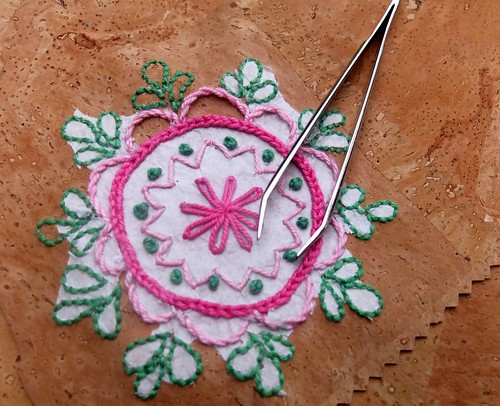
Removing tracing paper with tweezers, my photo
These embroiderers, holding a developed artistic sense, improvise in their compositions and are more worried about being faithful to tradition and creating beautiful and harmonious patterns than to truly represent the reality.
Usually the number of petals can go from 6 to 12 and it may arise finalizing a stem (the one I adapted was like this) or finishing a wide spiral. Some small motifs, arranged around it, as small "balls" and leafs, help enhance this motif. There are variations to the design of Japoneiras, recognizable by the trimming of the petals and the large center. You can browse in this document to find many different "Japoneiras",  the document is in Portuguese but the images are great!

I truly love this pattern and I was thinking what could I do with it... I decided this was the time to try something I've been delaying for a while... Frequently I use cork leather in my craft projects but I had never embroidered it...

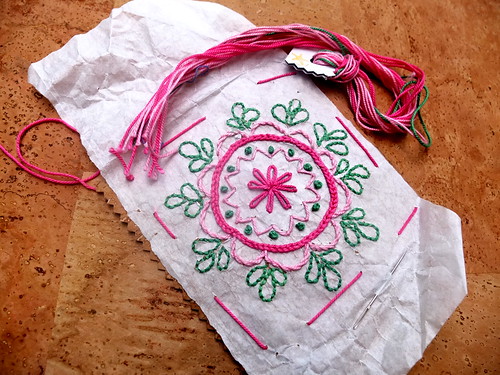
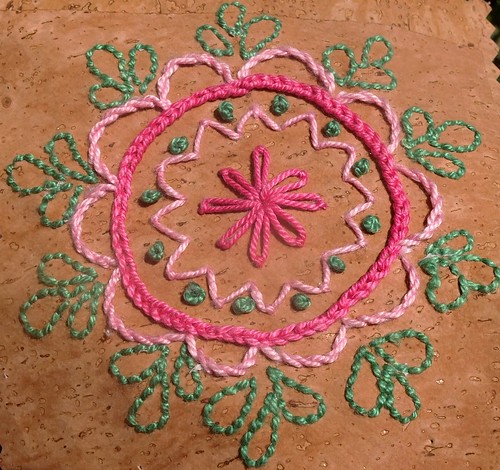
The Portuguese word for cork is "cortiça" and "sobreiro" for cork oak tree. Portugal is the number one world cork producer... Did you know? Recently new cork products have been created and cork leather is one of the greatest. I love it and I'm so happy that I tried it... It has some limitations... Satin stitch, the most used stitch in wool Viana do Castelo embroidery, is not appropriate and I had to choose other stitches also used in this kind of embroidery like stem stitch, backstitch, french knots, chain stitch and daisy stitch. Another difficulty is to transfer the motif: I decided, as I usually do, to use tracing paper and embroider through it. If your pattern is not too intricate it will work. Be careful to remove the paper, it's better to use tweezers... So here it is my JAPONEIRA embroidered on cortiça.

Japoneira - Viana do Castelo Pattern
Japoneira embroidered on cork leather, my photo
In the coming weeks I will be working on how to apply this piece of embroidery (if you have any ideas let me know) and I'm looking forward to seeing your wonderful embroideries that can be posted in our Flickr "embroidery" group . Feel free to use it in a creative way, I'll pick some to show here!!

Do you like this "japoneira" pattern? Isn't it great to know what's behind traditional patterns? They are full of life... And I hope they gain a new life in your hands... I would love to hear your opinion on this, could you please leave a comment when you download your pattern? Obrigada!

SITE DESIGN BY RYLEE BLAKE DESIGNS