Showing posts with label Madeira Embroidery. Show all posts

January 3, 2013

Stitches with Portuguese Soul - 2012

Olá! In the beginning of this new year I thought of reviewing "stitches with Portuguese soul, my participation here in feeling stitchy... It has been such an incredible experience...

I loved to know that so many of you already visited Portugal (and loved it...), that others still care for the strong relationship their families have with this country, that some knew Portuguese embroidery, and even others that have never heard about our "little spot planted by the seashore” are generous and kind enough to read me each week.
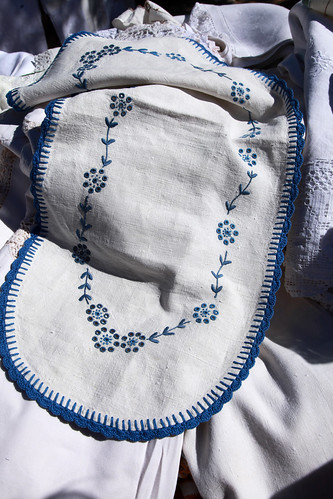
Vintage Stitches
Estremoz Flea Market, photo by ZPmoreira
We've started our journey with a very beautiful book, the first from Anchor's book series, Traditional Embroidery of Portugal... Do you remember?

I've been learning a lot... For this year's posts I will never forget the groups of women embroidering rugs sitting outside, in Arraiolos; the beauty of "Pauliteiros de Miranda" costumes beautifully decorated with picado; the young girls from Nisa that began working at early ages on their bridal trousseau and how their work helped them to begin a new life; how a treasure kept in a chest changed so many lives in Castelo Branco; how the natural beauty of the island inspired the first embroiderers from Madeira and the exuberance of these embroideries conquered the all world some years later; how embroidery can be a men's story, too as in Póvoa de Varzim; how a piece of embroidery can be a love letter as in Portuguese fiancé kerchiefs; and how a woman in difficult times was able to innovate by helping to create what we nowadays know as Viana do Castelo Embroidery.
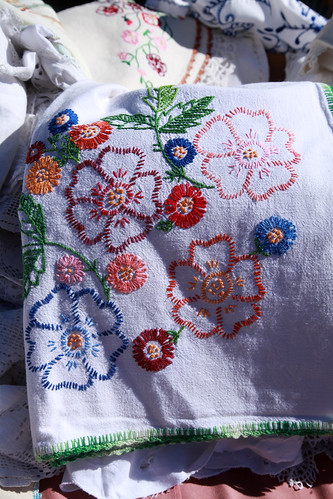


Vintage Stitches
Estremoz Flea Market, photo by ZPmoreira

I've also tried to show you some of my projects... embroidered necklaceembroidered card stock bookmarksembroidered notebooksbook cover tutorialChristmas lacing cardsChristmas memories notebook


And there is still so much to know... I will not forget to talk about regional embroidery from Caldas da Raínha, Tibaldinho, Guimarães, Lixa and Azores... I promise! And I'll bring in Portuguese cross stitch, too...


I also would love to show some more recent trends... And I'll begin doing it next week, showing the work of some new (not from old times...) embroiderers... 
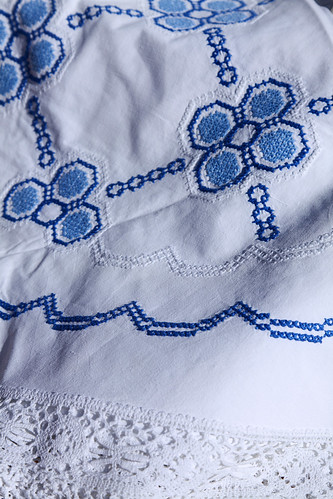


Vintage Stitches
Estremoz Flea Market, photo by ZPmoreira

I have to confess mixed feelings... I'm so happy because I know better Portuguese Embroidery and how in the past Portuguese people always felt so "stitchy" :). But at the same time, while trying to find some new embroiderers, I discovered that their number could be counted by the fingers of my both hands (maybe only one...), at least those that show their work in the web. Embroidery is still an industry, like in Viana do Castelo and Madeira... But other arts & crafts, not so traditional in Portugal, are taking the place of embroidery... And I feel said about it it... I truly would love to do something to change it. So... Here come my new year's goal!!


This year I would like to prove (above all to Portuguese people) that Portugal is a living museum of embroidery. In each home  there are so many treasures that we must show and be proud of. I believe that will inspire new embroiderers...


My motto for 2013 will be embroideries out of the drawers!!! I will challenge all of those who have Portuguese pieces of embroidery to show them and take pictures... If you are one of those lucky ones, are you going to join me???


But you can help me anyway... Tell me about what you liked (or disliked) the most in this journey... Or what would you like to read about in the time left... Can I count on your help??
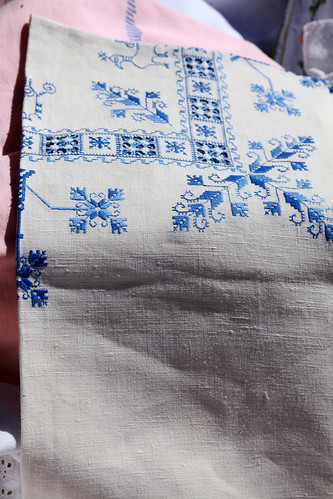


Vintage Stitches
Estremoz Flea Market, photo by ZPmoreira


I can't forget to thank you for being with me in this trip, for your kind comments and your emails... And the interest shown every week in the stitches coming from our small country...

And here you have some Portuguese words I've been talking about...  saudadelivro, obrigadajaponeiralençovestidobordadeiraenxovalbelezasentido artísticomãefilha, tapetestapeçariaorgulhosainspiradorpaicolchasmontepãotaleigocamisolaspicadoFeliz Natalamor

October 25, 2012

Portugal - a living museum of embroidery - part II

Olá! This a week we'll continue on our trip through Portugal, a living museum of embroidery. Today we'll be indoors, visiting an old family house near Estremoz, in the Portuguese region of Alentejo. Rural houses in the Alentejo countryside are called Montes. Monte means a small hill, an elevation, and in this region, very well known by its vast plains, usually houses were built on small hills. 

These photos were taken on a rainy day, like today... Which is not very typical once Portugal is a shining country!! But I believe this transmitted a special and beautiful light to the photos. Hope you like them!

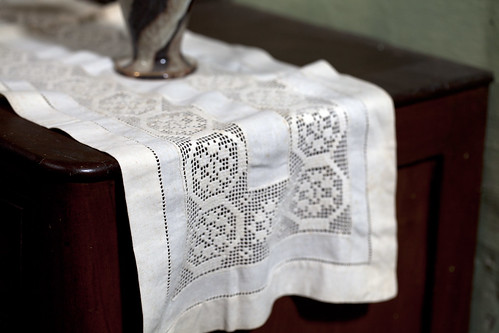
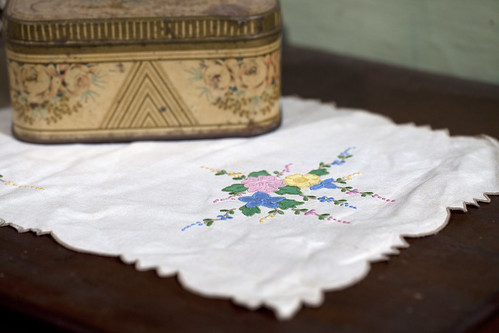
I believe that most of the embroidery pieces pictured were made by the grandmother and the great grandmother of the actual owners of the property, but I cannot be sure. I know both were great embroiderers since they have some signed beautiful pieces of embroidery. Most probably the photos show some designs and technique inspired by Portuguese Traditional Embroidery, but in this case again I cannot prove it. Beginning with this dresser cover, that I believe was inspired by Alinhavados from Nisa...

IMG_20121014_20117959
Vintage embroidered dresser cover, photo by ZPmoreira
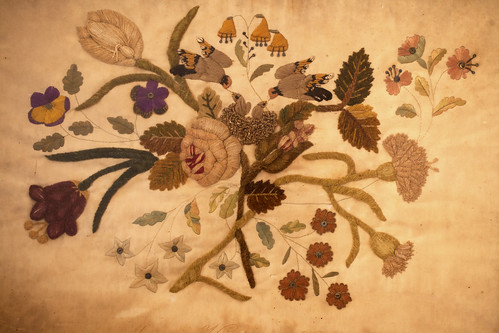
This floral silk embroidery is of unique beauty and, believe me, no photo would be able to show the richness of the stitches and all marvellous details. It is framed and signed by the grandmother of the actual owners.

Vintage stitches...
Beautiful framed piece of embroidery signed by the owner's grandmother, photo by ZPmoreira
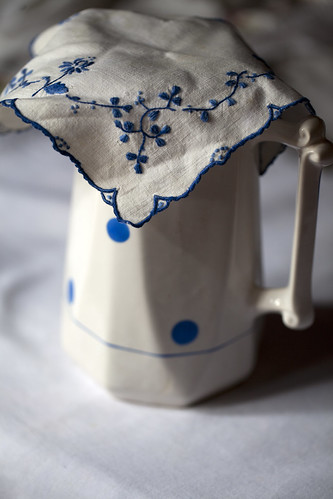
It's easy to identify in these blue stitches the influence of Azores embroidery. And there were more similar to this one... All charmingly beautiful.

IMG_20121014_20117981
Inspired by Traditional Embroidery from Azores, Photo by ZPmoreira
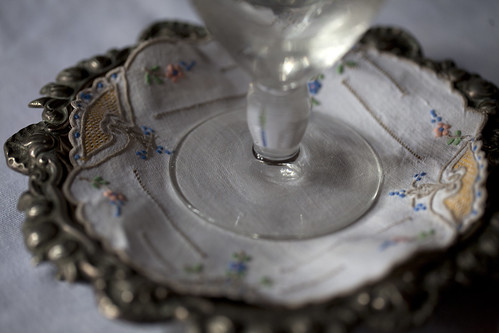
I can't describe the singularity of this extremely little and exquisite piece of embroidery. I believe its inspiration comes from Madeira Embroidery. Check here and here to delight yourself with some details.

IMG_20121014_20117976
Inspired by Madeira embroidery, Photo by ZPmoreira
This dresser cover with floral design is so colorful... I find some resemblances with a specific type of Madeira Embroideries, but in this case I would be much more careful to make this association... Charming, anyway.

IMG_20121014_20117961
Floral embroidered dresser cover, Photo by ZPmoreira
Some of these embroideries were being used, but many others were kept in drawers. As it happens in many Portuguese homes. I really would like to shout out loud: "Embroideries out of the drawers"!!

October 11, 2012

Stitches from an island in the Atlantic - part II

Olá! Beginning where we stopped last week
By the hand of Elizabeth Phelps, born to an English family settled on the Island, Madeira Embroidery was introduced to the British and after the 2nd half of the 19th Century these works of art began to be recognized as merchandise for trade between Madeira Island and the outside world.

She began with a school where poor workers where taught how to embroider. Initially, their works were sold to family and friends but when they were introduced to the British market their success occurred rapidly.

postcard - from Mindee, Finland
Embroiderers dressing regional costumes, old postcard from here
Madeira Embroidery began to be included in the families’ economy. At the beginning, embroiderers were responsible for the choice of fabrics and designs, using old family pieces of embroidery as inspiration. When the work was done, they would go to the harbour or door-to-door looking for someone to buy them, especially foreign tourists.

But with the growth of exportation, an enormous change in the fabrication process occurred: the designing and tracing phases went out of the hands of the embroiderers. The women living in the countryside received the fabric already prepared and then developed an extraordinary work of perfection with their agile and patient hands transforming the designed fabrics in unique works.

Madeira embroiderers gathered, photo from here
The embroiderers usually worked at farming with their husbands and they learned the art of embroidery from their mothers who were also embroiderers. Since the end of the 19th century, beautiful postcards captured and popularized images of the embroiderer seated in front of her cottage and groups of women who gather on the edge of ways to embroider.

Throughout the whole island, married and unmarried, old and young women were found together embroidering while talking about their lives and other’s lives…

But, as said before, embroidery in Madeira changed forever with Miss Phelps… As documented by popular oral tradition not only women knew the arts of needlework: Embroiders the father, embroiders the daughter, embroiders the mother… (popular verses)

Mother and daughter embroidering, image form this book
Another difference brought by Miss Phelps’ transformations was the fact that many embroiderers were no longer embroidering for pleasure but for need… But this has not diminished the value of their work… Madeira Embroidery is still a luxury item. Its value comes not only from the beauty and refinement of the design, the combinations of materials and the profusion of stitches but also from being an authentic handcrafted work. Each embroidery is an unique work of art, receiving the embroiderer’s personal touch.

Max, a famous Madeiran (born in the island), co-composed a song in honor of these women.
This is an old record, but we can hear in his voice with a strong Madeiran accent (I believe only Portuguese people can distinguish it..). Here you'll find a more recent version.

The lyrics says (talking about Madeira Island):
Like you there is no other
And in the dreamy nights
The waves foam is stitched
By the fingers of the embroiderers

In Portuguese (I made a very, very free translation...)
Como tu, não há nenhuma
e, nas noites sonhadoras,
Bordam das ondas a espuma,
Os dedos das bordadoras.

October 4, 2012

Stitches from an island in the Atlantic

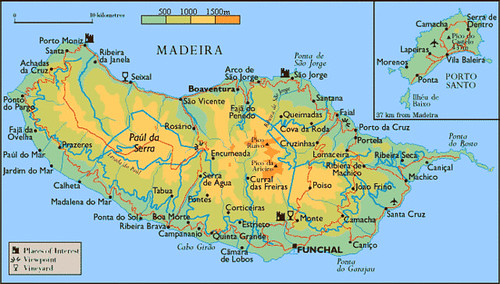
Olá! Continuing to travel through the roots of Portuguese traditional embroidery we have to leave mainland Portugal towards an archipelago in the Atlantic Ocean.

Madeira archipelago, i took this pic from the net
Madeira and Porto Santo, from here
Madeira appears in a map for the first time in 1433. Some years before two Portuguese captains had discovered an island in the Atlantic where they anchored after a storm, they named it Porto Santo (Holly Harbor). One year later was the time for the arrival at Madeira, that means “wood” in English. 

So… About Madeira’s history we can say that the Portuguese have put this archipelago on the map, but no one doubts that these islands were already there… The same happens with the history of Madeira Embroidery. Many claim that its history begins in 1850 with Elisabeth Phelps, but that is not true… She just put Madeira Embroidery on the map… But it was already there...

Today I’ll talk about what inspired the first embroiderers, those living before 1850 and next week we’ll see what changed after that…

Linen Madeira Embroidery, photo from an antiques blog.
The history of Madeira embroidery began with the first settlers on the island. Soon after their discovery the islands received the first inhabitants and their first embroiderers, too. The captains that first arrived at Madeira brought their families to live with them on the island and many other noble families followed. Fulfiling the need for the decoration of household linens as well as of clothing, noblewomen embroidered in their homes and nuns embroidering in convents were also known for their handcrafted work.

Most of the women that first arrived came from the North of Portugal, and many specifically from Viana do Castelo region, bringing with them the ancient tradition of embroidery and great skills. This art soon spread to almost all women of the island, even to those living in remote rural areas of the interior.
Women embroidered for own enjoyment or as gifts for their relatives and friends. For the young woman, the tradition of the wedding trousseau was very often the reason for such patient dedication to needlework. Embroidery pieces were passed from generation to generation not only for their great sentimental value but also for the richness of the embroidery.

Organdy Madeira Embroidery, photo from an antiques blog.
Although following the tradition, we can say that Madeira Embroidery is more exuberant than other Portuguese regional embroideries maybe owing it to the natural exuberance of the island that surely inspired embroiderers.
Nature lends its movements to embroidery, giving the embroidered items their uniquely respectable, refined romantic characteristics. In particular, the gracefully flowing movement, the composition of natural motifs where the abstract and imaginary flowers, as well as geometrical figures, provide graciousness and refinement in the embroidered items. (1)

The Madeira needlewoman became an expert in all types of needlework, from Cut Work to colored embroideries and tapestries in Tent Stitch. (2)

Ceramic Tile representing Madeira emboiderers, poto from this blog.
In the second half of the 19th century a woman born in an English family that was settled in Madeira since the 18th century started an embroidery school to teach impoverished workers. And she changed Madeira Embroidery forever... That story continues next week...
SITE DESIGN BY RYLEE BLAKE DESIGNS