Showing posts with label Portuguese embroidery. Show all posts

April 24, 2014

Between Portugal and Scotland on the tip of a needle

 Olá! The Scottish panels are finished and already safe in Scotland!!

Since the beginning, we had in our mind that we should "impregnate" both panels with our Portuguese embroidery soul... And that was the reason why we decided to choose, as much as possible, the stitches that are the most traditional in our regional embroideries... And that ended to be a great decision... 

All the great choices belonged to Méri Almeida and Sofia Amaral M who led this giant effort of many embroiderer volunteers.

At the center of both panels, to fill in the cask, the most popular stitch from Castelo Branco Embroidery was used: "frouxo" stitch (frouxo means "loose), Castelo Branco Stitch or Oriental stitch - different designations for the same stitch profusely used in this silk embroidery but that ended being perfect in wool embroidery. Agulhas da Meri suggests this link about this type of embroidery that can be called laid-work.

But there were many others... Like the Portuguese stem stitch decorating the end of the cask on the Lisbon's panel or the four corners using four different stitches from Castelo Branco's embroidery. 

At some point the embroiderers from Lisbon noticed that the wool yarn would not be enough to finish the four corners as it was supposed to. There would be slight differences in the colors... What seemed to be a problem, ended in such a great opportunity to enrich the panel... And four different stitches ended up decorating each corner of the panel, illustrating the richness and beauty of our Castelo Branco embroidery. Beginning bottom right and going clockwise we have:  rede torcida (twisted net); pé de galo (cocksfoot); velhinhas (old ladies); crivo fingido (pretended openwork) (note: the designations in English  are literal translations and not the real name of the stitches).

It was a very simple pattern, but at the end we had a beautiful panel, so balanced with the stitches' choice for the center and the corners...  

Lisbon's panel and its four Castelo Branco's corners

And the same effort happened in Oporto. The bullion knot, (ponto canutilho) very popular in many Portuguese embroideries from the North of the country and the "soul" of Guimarães Embroidery, beautifully filled in the white wig and one of the Castelo Branco's Stitches brought color and texture to the vine leaf. The choice for the bushy mustache was brilliant: the velvet stitch, from Guimarães Embroidery, was everything George Sandeman needed... And the Grilhão Stitch (Palestrina Stitch), very present in Caldas da Rainha Embroidery (and in so many others...), was perfect to fasten the mast of the Rabelo's boat. 


Portuguese embroidery on a Scottish design, two countries on a panel.

We ended this journey between Portugal and Scotland on the tip of a needle celebrating with Porto Wine... and we are already feeling saudade, such a Portuguese "mood"... 


Wine Port, Portugal and Scotland, a journey on the tip of a needle...


Don't forget to check the Scottish Diaspora Tapestry, once each day new panels are arriving from all around the world with incredible examples of beautiful wool embroidery...

March 27, 2014

Scottish Diaspora Tapestry - Portuguese Panels

Olá! Two weeks ago I introduced you to the Scottish Diaspora Panel and promised to show the panels that were sent to Portugal.

George Sandeman's panel
We received two panels designed and drawn onto linen, a colored pattern and wool thread. We should choose our own stitches to bring the design to life. Both designs represent the Porto Wine industry. There is a third panel, depicting Sir John Drummond (John of Scotland, Joao Escorcio) in Madeira in the 15th Century, but it is being stitched in Scotland.
The panels are very different from each other, which happened to be a great way of creating different experiences around them.

Port Wine families' panel


There is a panel representing George Sandeman that was sent to the North, the region of Porto wine. The panel has a much more intricate and detailed pattern. The North of Portugal is the region where we find most of Portuguese embroidery traditions...

So we decided to have it embroidered there, in the North, in a more traditional way, using the stitches more common in our regional embroideries.


Méri Almeida from the blog agulhas da méri became responsible for this panel, coordinating a team of volunteers that have been gathering on a daily basis...

Lovely details including the mustache using velvet stitch from Guimarães embroidery
Méri was the best choice I could have ever made... She knows all the details of our traditional stitches, she loves to use embroidery technique at a high level, and puts her heart into each stitch. The photos showing the team working tell us that this is the spirit being lived there... 

The hair is growing day by day with incredible "canutilho"stitches (bullion knots), the soul of Guimarães embroidery

In the North we have the panel of the technique and rigor... But the door is always open and whoever wants to help or see the panel will be welcome.


The grapes are finished and the first vine leaf is almost done...

The other panel represents many of the Scottish families related to Porto wine industry and the design is simpler, not giving opportunity for using many different stitches.


Using "ponto frouxo" or Castelo Branco Stitch to fill the wine barrel

And the simplicity of the design was used with mastery by Sofia, from the blog Tayari, a borboleta serrana. Instead of a very technical panel, in Lisbon, we have one in which many participate.

A group of volunteers, in Lisbon, stitching the outlines using stem stitch.
For several days Sofia received volunteers in a public space in Lisbon, where they gathered to embroider all the outlines in stem stitch. In a weekend she traveled to Sintra in order to work with another group of volunteers, including a Scottish lady. She was in an Embroidery School, where a teacher of the Castelo Branco embroidery began filling the wine barrel at the centre. And she managed to take the panel to a public school where a group of 10 year old students experienced the joy of embroidering for the first time... Next weekend the panel will travel to a rural region of Portugal and there some very skilled embroiderers will also be able to participate.

The panel at the school, where students learned history, geography and embroidery technique

Sofia is coordinating all these different volunteers and at the same time ensuring the quality of the stitching. The stitches that have been chosen are giving the panel such a textured touch... That's not an easy job and Sofia is coordinating it always with gentle words and a smile on her face...

One of the four corners of the Port families' panel. 


This is an incredible experience for all of us... A truly feeling of celebration inspires all the volunteer embroiderers, regardless of their age and experience... We are celebrating our "global village" in this journey between Portugal and Scotland on the tip of a needle! 

March 20, 2014

Welcome Spring

Olá! May Spring inspire our stitching...


These stitches belong to Maria Alice, with fairy hands... And the inspiration came from the beautiful poppy fields of Alentejo.

*next week I'll bring the news from the Portuguese panels of the Scottish Diaspora Tapestry.

February 20, 2014

Portugal - a living museum of embroidery part IV

Olá! This week I remembered that I had some photos that I've not showed yet.

So... come with me and accept my invitation to continue our visit to a very special museum... to Portugal, a living museum of embroidery...

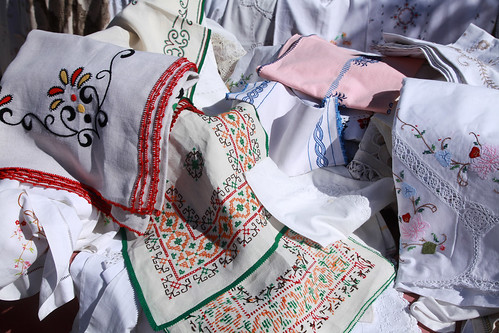
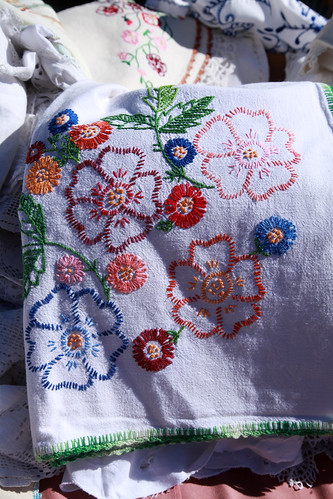
As I told you in our first visit it is very common in antiques and flea street markets to find someone selling vintage embroidery. These photos are from a street market in Estremoz, but all around Portugal you'll find the same... from the North to the South of our country... this happens in the street... but indoors it is no different. I believe you'll find a piece of embroidery almost in every single home.

And this makes me think of all the women that embroidered these stitches that lasted until today... Can you imagine so many hours? So many women...


Vintage stitches

Vintage Stitches

Vintage Stitches

Vintage stitches

If it is still possible to have all these in our days, I can't avoid thinking of how different life was those days when these treasures were stitched...

I really would love to know if in your countries it's as easy to find a piece of embroidery as it is here, in this very special living museum of embroidery.

February 13, 2014

Challenged by embroidery with Portuguese soul - Margarida

Olá! As love is in the air, today I bring you very beautiful images that I was saving for a special occasion... And that day has come...

As you may know I write on a weekly basis showing "stitches with Portuguese soul". Usually discovering the history and tradition of embroidery in my country or showing the work of Portuguese embroiderers.

But this year I decided to try something different, too. Although embroidery is deeply rooted in our culture, it is not so present in recent craft trends... so I decided to challenge some of my favorite Portuguese crafters that usually don't use embroidery in their works, to change that at least for a day. And I'll be showing their embroidery stitches.


Pastel palette instead of traditional colors

And I definitely have to begin with Margarida. Some years ago, when I was starting my project, she was the first that gently decided to present it to the "blogosphere"... I can say that I debuted in her blog pano pra mangas...

Her blog is very popular among Portuguese crafters (but not only...) and as we would say in Portugal: she is a mulher dos sete ofícios - something like "jack of all trades". In her blog everything looks beautiful and charming... and her words are always kind and inspiring.

I'm very happy that Margarida accepted my challenge and what I like the most about her embroidery is that it says a lot about her... the colors, the motifs, inspiring words and everything planned to detail...

I asked Margarida if she could create something inspired by Portuguese embroidery but doing it "her own way"... She says that she was inspired by the hearts from Viana do Castelo and by the tradition of using words in Lenços dos namorados. But no doubt she has done it her own way...

This is my turn to present Margarida... and I leave you with her own words...


Sweet stitches

"When I think about myself and who I am, I always end up with a question mark. Not that I am a question without an answer, it's the other way around - I AM too many answers. Lately, the best way I find to describe me is by comparing me to a department store!

I'm a happy person. I'm happy wherever I am, as long as my family and friends are at a two hours flight distance and I'm surrounded by hundreds of crafty materials that can ignite my imagination.

I learned to knit when I was 6. My first embroideries are dated from when I was 7. And I made my first crochet chain when I was about 8. Yarns, fabrics, embroideries, hoops or anything else imaginable are part of my life just like carrots or peas... I'm a very lucky person to have a very talented mother and grandmothers who taught me what they know.


Many details

I love everything crafty! And as I'm also a very curious person I'm always jumping from one thing to other, trying new techniques and bringing to life what I dream of when I'm sleeping.

And then, my blog... I've been blogging for nearly 9 years. My blog is where I love to share my crafts, other talented crafters, places I visit, books I read, beautiful tutorials and some of my personal achievements. In 2011 I gave up my long term job. In January 2012 I moved to London and last August I decided to return to Portugal in order to begin another project: to be a Life Coach! Oh, and I cannot forget my plans of growing rhubarb in the hot sunny Algarve...

When Gabi challenged me to do embroidery there was one thing I knew: it had to have a heart (I've got a crush on hearts and I find them everywhere). First I thought I couldn't do it because it had been a long time since I had embroidered anything, but then I sketched directly in the fabric, chose the colors and started doing it. It was easy. I loved it and I'm thinking about repeating this experience as soon as possible."

Inspired words

Maybe Margarida forgot to say that she is romantic, too... Her embroidered words don't lie:
Amo-te no silêncio do teu sorriso... 

This time I won't translate... try by yourself to find the meaning of these words...
Have a happy Valentine's Day, inspired by stitches with Portuguese soul.

January 16, 2014

Beautiful key chains from Portugal

Olá! Today I'll continue on last week's Portuguese blog, cesto da roupa, from the hands of Isabel Jardim. And this week I tried to learn a little bit more about Isabel's relationship with embroidery...

Like many of you (I believe...), Isabel's first stitches were at school, embroidering perforated cards.
Her love for embroidery is an old love. And for a long time she embroidered and sold many, many commemorative (birthday, marriage...) cross stitch works.

Winter look...
She likes to see motifs gaining color and volume. Often she does not use a pattern, especially with floral motifs - Isabel embroiders freely, until the whole piece looks balanced and harmonious... and she certainly has a gift for creating charming flowers!

In blue...

As the photos of last week show, she believes that a small embroidered detail makes a piece of work really unique!

Pastel...
I decided to keep these photos for last, since I'm completely crazy about them... These key chains won my attention when I saw them in a craft fair and I decided that I had to show them here...

So delicate...

I was not expecting it to be so difficult to choose the photos... I like each and every one of them...

Red, red, red...

Green and pink...

Do you know what Isabel's family name, Jardim, means in Portuguese? It means "Garden"... and that's what this post looks like!!!

January 9, 2014

Cesto da Roupa...

Olá! The first weeks of this year I'll be showing some more works from Portuguese embroiderers. I believe it is a great way of beginning the year... isn't it?

And let's begin with Isabel Jardim and her blog "cesto da roupa"... I would translate it as clothes basket... Because I believe she did not mean laundry basket... but maybe the real problem is with my English. :)

I got to know her work three years ago and I loved the originality and freshness of how she worked with fabrics... so different from what I usually see. But I only discovered embroidery on her work very recently...

Some years ago Isabel begun publishing beautiful painted  laundry bags and bed sheets but soon her charming bed covers became a success and I believe that was when she started showing her embroidery stitches... soon delicate stitches began embellishing many of Isabel's works. And she brought them from the bed to the table. Later, her doll lavender bags with cute embroidered faces were the confirmation that embroidery was there to stay. :)

Today I bring you some photos of more recent pieces of work with embroidered details that make them so special and unique... 


Photos from Cesto da Roupa
Photo from Cesto da Roupa

Isabel's bunting banners and this beautiful bag embroidered with little birds show her inspiration from vintage motifs...


Photos from Cesto da Roupa

 And this toilet bag surely shows Isabel's preference for floral patterns...


Photo from Cesto da Roupa

Lately, Isabel has been dedicating some of her stitches to our little friends... and she embroidered a beautiful collection of pillows for pets...

But I will leave the best for last... so don't forget to pass by next week. I'll show you my favorite works from "cesto da roupa" and you'll learn a little more about Isabel and her relation to embroidery.

November 14, 2013

New life for old embroidery

Olá! This week I bring you a very inspiring and simple story about very simple and inspired people. This story begun more than 50 years ago in Paredes de Coura, a municipality in the North of Portugal, Minho Region, near form the frontier with Spain.

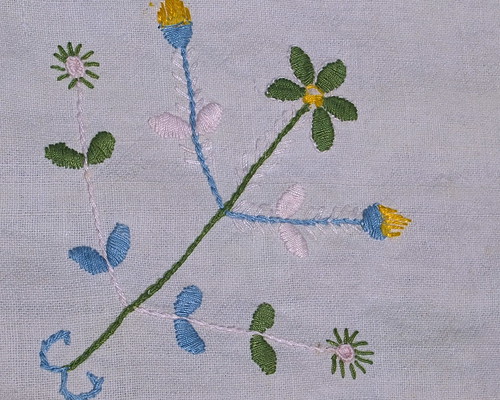
All around our country, fifty years ago, unmarried girls prepared their bridal trousseau with their own hands. In this big family living in Paredes de Coura, sisters gathered at night after work to embroider, make lace or spin... The images I show you are from a linen bedsheet embroidered during those late sessions by one of these sisters.

Old embroidery from Paredes de Coura
Old embroidery
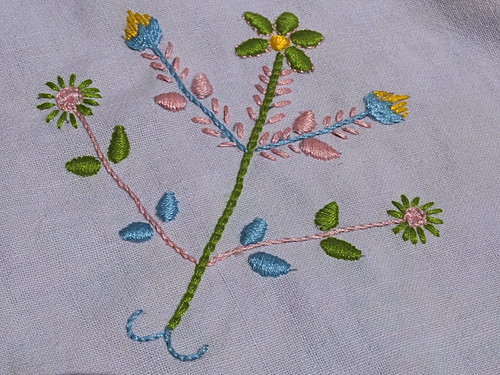
Reproduction of old embroidery from Paredes de Coura
Reproduction of old embroidery
These girls were not experts... And there were no patterns (riscos as it is said in Traditional Portuguese embroidery) to follow. Paredes de Coura is not a place especially recognized by its embroideries like other municipalities from Minho Region are. So these girls used a pencil and by their own hand traced the motifs without having to respect any rules... only as their hearts dictated. And I believe that's the reason why these motifs are so incredibly naif and beautiful.

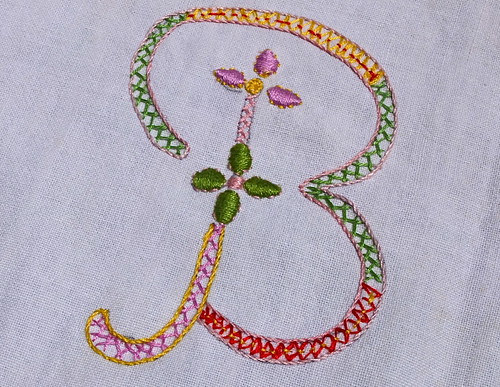
Old embroidery from Paredes de Coura
Old embroidery
Reproduction of old embroidery from Paredes de Coura
Reproduction of old embroidery

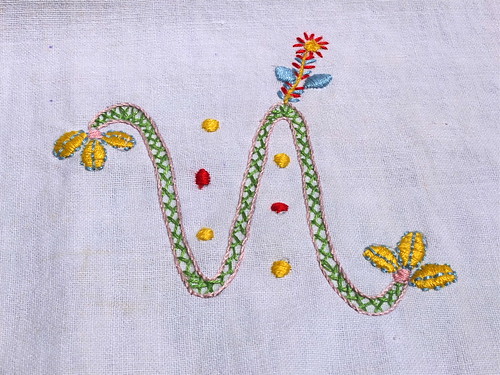
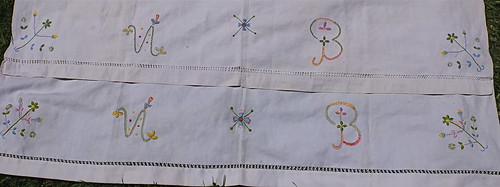
This bedsheet was embroidered with the monograms of the embroiderer and her fiance "B & N". As you can see in the photos, the "old stitching" was not perfect... And I even cannot recognized some stitches... I believe they were guided by instinct instead of being "official" stitches (maybe I did not made myself clear...).

The imperfect stitching, the lack of rules in tracing the patterns and the color choice (green for flowers) in my opinion, make this piece of embroidery absolutely charming, showing what happened late at night in many, many Portuguese homes fifty years ago...

Old embroidery from Paredes de Coura
Old embroidery
Reproduction of old embroidery from Paredes de Coura
Reproduction of old embroidery

But this story doesn't end here...

Many years later the artist of the original piece of embroidery made it a gift to her niece, Maria Alice, knowing that she would appreciate it. Besides being a great embroider, Maria Alice belongs to a traditional folklore dancing group (rancho folclórico) and she could use it to recreate traditional costumes.

But Maria Alice came out with better idea... She decided to make a reproduction (or maybe a recreation) of the original embroidery using the same linen of the bed sheet. And she gave the original piece and the recreation to both daughters (her cousins) of the embroiderer from 50 years ago. I believe this was such a surprise for them...

The original piece of embroidery and the reproduction
Original and reproduction
This is a very simple story, but I believe that it tells a lot about our (simple) country... And stories like these are the reason why I always say that Portugal is a living museum of embroidery...

September 19, 2013

Inspired by olives?

Olá! I truly believe that traditional embroidery from Portugal tells the history of our country… And you already know how much I like my patterns to be inspired by Portuguese traditions and culture… Of course I love many other types of embroidery motifs, but I have to say that the ones rooted in the “Portuguese soul”  inspire me the most…

I believe you also have those unique kinds of patterns that are special to you… Haven't you?

The pattern I bring today is not a traditional one but it reveals a bit of Portuguese history and a lot about Portuguese culture.

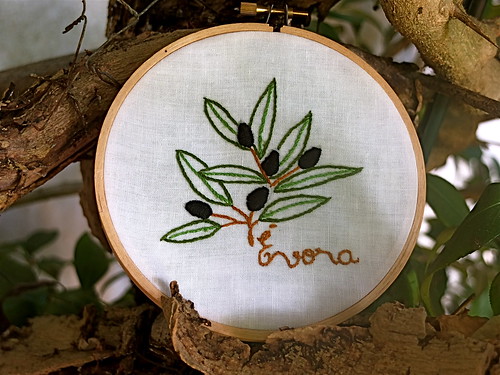
It was inspired by a pottery piece from Alentejo and embroidered by Maria Alice. And it was the perfect tip to show you a little more about my country…

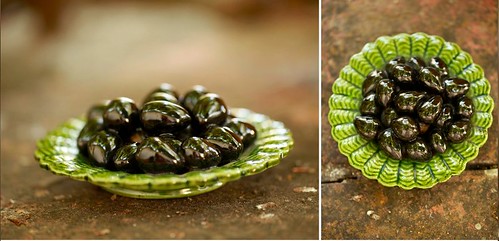
Olives and Olive trees

The olives reproduced in that simple and beautiful embroidery takes part of our gastronomy, agriculture production (Portuguese olive oil is among the best of the world), crafts - using olive trees' wood or ceramic  - and even popular music (one of the most traditional songs here sung by Portuguese singers)...

Traditional Pottery Inspired by Olives...

Our Mediterranean type climate is very supportive of the growth of olive trees and olive oil, obtained from the fruit of the olive tree, has been produced in Portugal for many, many years. There is evidence that olive trees existed in Portugal back in the Bronze Age and the exportation of olive oil dates back to Portuguese maritime explorations.

Did you know that an olive tree can live thousands of years? And that Niel Armstrong left a golden olive branch on the moon as a symbol of peace?


Olives embroidered by Maria Alice
As you see a very simple pattern can be full of meaning... That's another reason why art, in this case, embroidery, makes our lives so special...


August 1, 2013

Still the fiancé kerchiefs...

Olá! This week I'll be brief... Only to show you two more images of fiancé kerchiefs inspirations...

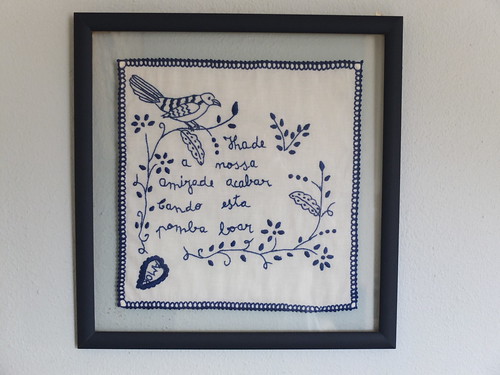
The first one is a framed fiancé kerchief. It is monochromatic what is not so usual... The same embroiderer from last week.  It is very common that these kerchiefs have some embroidered messages. A long time ago they were embroidered by girls that often did not know how to read or write...  But they were in love and still they wanted their beloved to know that... So it is very usual, and now a tradition, these kerchiefs being full of misspelled words (in Portuguese: erros ortográficos)... Sweetly naif... That's what happens with this kerchief... Nowadays being able to write with this naif mistakes is almost an art and this one is a very sweet example.

DSCF9966
Embroidered by Maria Alice

In correct Portuguese it should be: Há-de a nossa amizade acabar quando esta pomba voar. Instead we read: Hade a nossa amizade acabar cando esta pomba boar...
In a very, very free translation and adaptation... "Will our friendship end when this dove fly" With some misspelled words... "Wil our friendship end wen this dove flie"... I confess I don't know the most "popular" English misspellings... I believe all languages have them :)

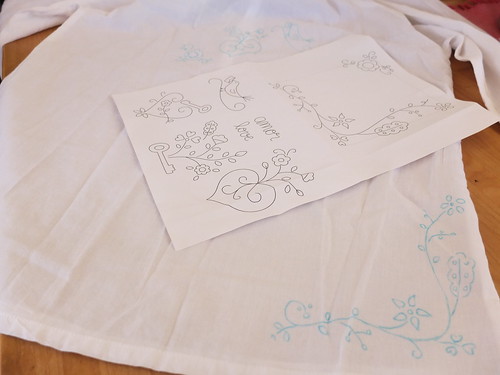
New embroidery pattern inspired by Portuguese traditional fiancé kerchiefs embroidery
Work in Progress...

This other photo shows the work I have in hands... I've finished the patterns inspired by Portuguese Fiancé Kerchiefs that I was working on and they will be available soon... I'm happy with them. I had the help from a very talented friend!!! I used the motifs to decorate a child blouse. As soon as it is ready I'll show it again. I'll keep my promise!!


July 25, 2013

Mãos de fada - fairy hands

Olá! In the past weeks I've been working on some Portuguese traditional patterns, trying to gather some motifs that I want to make available. Fiancé kerchiefs were the first ones to claim my attention. I've done some research, trying to understand which are the most authentic motifs, the ones that respect the certification process that now rules this type of embroidery.

I share with you some of my finds...
There are not very precise rules for the motifs nor for the colors... However, love is the most important source of inspiration and primary colors are the most common. Tracing appears to be very asymmetric on the popular kerchiefs and the triangular interpretations predominate. There is a list of stitches that are accepted but I would say that stem stitch is really the one that characterizes this regional embroidery, followed by satin stitch.

Soon I'll tell you more about the most typical symbols found on this type of embroidery... Today I bring you some very simple but beautiful pieces of embroidery using patterns inspired by fiancé kerchiefs.

They were brought to me by a dear neighbour that lives down the street. They were embroidered by someone that has mãos de fada (fairy hands) an expression we use describing someone with a special ability and talent for handwork... Her name is Maria Alice. And they were not gifts of passion but gifts of friendship.

Fiancé kerchief patterns
Hearts - one of the most popular symbols used in fiancé kerchiefs
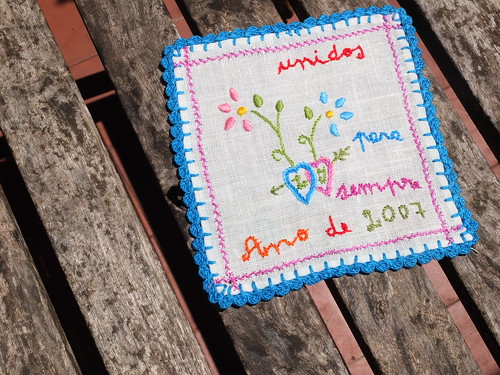
Small fiancé kerchief
A very small fiancé kerchief - together forever, year of 2007
Fiancé kerchief pattern
To keep a jar of jam...

Next week I have more...


June 6, 2013

Portuguese embroidery supplies - giveaway

Olá! Today is a giveaway day!!

My shop, agulha não pica has been searching for Portuguese embroidery supplies and researching their history and I am now very happy to announce that we'll become a very proud seller of embroidery pearl cotton size 8 and pure line fabrics. Both made in Portugal!


Some weeks ago I talked about Limol pearl cotton and last week I introduced you to the long lasting tradition of linen production in Portugal.


This week agulha não pica is giving you the opportunity to see the beautiful colors of the pearl cotton with your own eyes and feel the amazing touch of pure linen with your own fingers...


From now on you'll be able to find in agulha não pica's etsy shop both light weight and heavy weight Portuguese linen, made in Guimarães - a region well known for the excellence of its linens for more than one thousand years... And a new pack of embroidery cotton pearl, size 8 is available now, too.


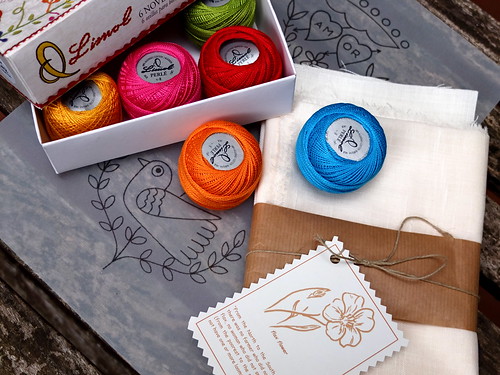
To celebrate the good news, agulha não pica will be offering a pack of embroidery supplies with Portuguese soul... One fat quarter (20"x20") of heavy weight linen and one fat quarter (20"x30") of light weight linen with a beautiful box of six pearl cotton balls size 8 and two Portugese traditional patterns printed on tracing paper.


Embroidery supplies with Portuguese soul
"Embroidery supplies with Portuguese soul" - which regional embroidery has inspired the color choices?

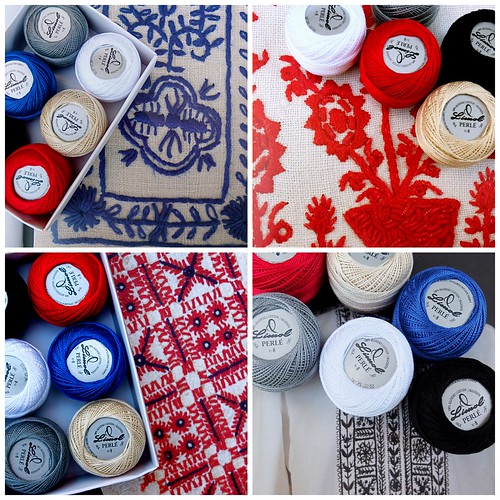
And agulha não pica is so delighted and proud that we will also be giving a box with six balls of cotton pearl size 8: blue, white, gray, black red and ecru...


Collage pearl cotton guimaraes
Pack with six balls of cotton pearl size 8 - which regional embroidery has inspired the color choices?

To win, check both posts: "pack of embroidery supplies with Portuguese soul" and  "pearl cotton balls box"  There you will find information on which regional Portuguese embroideries inspired the color choices of each box.


Leave a comment on this post with the two regional embroideries that inspired the color choices of the pearl cotton boxes in the photos. You have until 9 PM Central Standard Time, Sunday, June 9th to enter. Just one entry per person, please. And there will be two winners!!

Boa Sorte! Good Luck!
SITE DESIGN BY RYLEE BLAKE DESIGNS