Showing posts with label Viana do Castelo. Show all posts

January 30, 2014

From Viana with love and cork

Olá! Today I'm continuing from last week's post showing the incredible work of Teresa, from Artesaté, that recreates the Portuguese traditional embroidery of Viana do Castelo, from the Minho region.

Tradition says that the embroiderer must use a cotton thread in blue, white and red. And Teresa uses blue, white and red... but the shining of Viana's jewelry inspired her to use gold, too..

Tradition says that the embroiderer must use cotton and linen fabrics... but the need of modernizing her work inspired Teresa to use felt and, lately, cork fabric, too...

Tradition says that the embroiderer must use hearts, japoneiras, oak leaves and clover leaves as motifs (among others)... but lately the embroiderers have forgotten the leaves... and Teresa, inspired by her wish of being faithful to the genuineness of Viana's embroidery and her permanent desire of knowing more and more, recovered the clover and oak leaves in her stitching, too.


Blue, red and white, the most traditional colors in Viana do Castelo Embroidery.


Teresa argues that the impressive presence of gold jewelry in her home city, Viana do Castelo, was the main influence on her choice of using metallic threads in her embroidery.

Born 100 years ago, the "modern" Embroidery of Viana do Castelo, suited for home linen, is now subject to a certification process that requires the respect of some rules which dictate the non use of golden thread. However, more than 100 years ago, the embroidery tradition was deeply rooted in this region, with a widespread use of wool yarn to embellish women's costumes: skirts, pouches and waistcoats. As you may confirm if you follow the links, this embroidery was profuse in the use of color, including metallic threads. Today these threads are not common, with the exception of their use in embroidered boxes, very popular in Viana do Castelo.


In gold, inspired by the rich jewelry.

The choice of the clover and oak leaves as well as the use of cork are the latest innovations in Teresa's work. And the photos I bring are very recent...

In the traditional embroidery from Viana do Castelo, clovers were popular patterns. Seventy or eighty years ago there were three and four-leaf clovers and their size varied greatly, but nowadays the clovers are rare and very small. In the past, the patterns inspired by nature were stylized by the embroiderers from the Minho region. Driven by emotion, while creating a clover, the embroiderer could not resist to draw it by the joining of three or more hearts, reinventing once and again the love pattern. And that's what we find on the last embroidered heart by Artesaté, that uses this lately recovered motif and the blue from Viana's ocean.


At the top the three-leaf clover, joining three hearts

It may sound unexpected but Teresa feels that Viana's embroidery and cork, being both famous symbols of Portugal, make a unique combination of textures and colors. It's natural that her words about the joy of embroidering on cork fabric may be overstated due to the excitement of a new love, but still they are worth being translated:

"It's a slow job that needs more attention. Stitches must be perfect at the first attempt, there is no space for errors once if you need to undo your stitching the cork fabric will be damaged. But the final work is special, more perfect, of a smoother texture to the touch and more rustic in appearance, which fits in perfectly with the tradition that I intend to transmit. The smell of cork fabric is one of the things that pleases and fascinates me the most, it spreads through the office making me feel that I'm working with nature and tradition."


In white, like tradition dictates... And recovering the oak leaf (at the top) forgotten in recent years.

Knowing how Teresa works, I'm already curious to see where this unique combination of tradition, innovation and love for Viana will take her...

January 23, 2014

From Viana with love

Olá! Today I bring you something very special... Definitely this is a Portuguese story... And as we would say in Portuguese: a história de uma mulher do Norte - "the story of a woman from the North"...

Sometime ago I told you how the Traditional Embroidery of Viana do Castelo was so intricately interwoven with the story of many women. And how the birth of what we recognize today as this regional embroidery helped so many of them find a new way of life - that is still deeply rooted in the culture and the traditions of the North of Portugal.


Teresa embroidering and wearing the domingar costume (to be used on Sundays)

The story of Teresa, that I bring you today, bears some resemblance to the one I told you before. This is also a love story for Viana and again a proof that with courage and talent we can change our lives.


An original Christmas crib winner of a contest promoted by the municipality of Viana do Castelo

Teresa was born in Viana do Castelo and the traditions, the culture and the folklore of this region were always present in her daily life since she was a little child. As happens with other women and men from this city, Teresa waited, and still waits, all year for the festivities dedicated to Our Lady of Agony, Romaria da Senhora D’Agonia, one of the most rich and genuine ethno-folklore festivals of our country. These are special days, when Teresa proudly wears the folk costume made by her own hands and holds the famous gold jewelry while the colorful folk dance groups musically enliven the ambiance and invite everybody to dance (be sure to follow this last link and watch how common people follow the dancers and fully enjoy it).


An embroidered brooch inspired by the skirts of folk costumes

Embroidery came into her life, by the hands of her mother, so naturally as all the other cultural traditions from Viana did. Inspired by the lively colors of the costumes - the bright red, the shining gold - and by the embroidery that decorated the linens of the house where she was born, Teresa discovered this new way of living. After some years teaching arts and technology to children she decided to devote her life to reinvent Traditional Embroidery of Viana do Castelo creating embroidered accessories that adorn our days: key holders, brooches, small cushions, beautiful frames, wedding favors...


Details of Teresa's stitching

Viana é amor, a popular saying that means "Viana is love", justifies the massive presence of Viana's heart in the crafts and culture of this city. That special heart is everywhere... In the noble art of filigree, in gold jewelry works, in embroidered table linen. For many, the heart of Viana even became one of the symbols of Portugal. Teresa elected the Viana's heart as the symbol of her work - Artesaté, because in Viana, quem gosta vem, quem ama fica - the one who likes comes, the one who loves stays.


Viana's heart - the symbol of Artesaté's work


Teresa feels that her life is unique and special because she was born there, in that special place, where the river meets the sea under the eyes of the hill of Santa Luzia. And Teresa, believe me, has developed the art of bringing to each piece of her work this uniqueness that only someone who belongs to a special place may have... Each stitch tells a story of joy, color and love...


Viana in gold

"Viana is more than a city, it's a way of living... a way of being that lies deep in the soul and the blood of those who were born there..." These are Teresa's words and she reinforces; "That's what I am".

Note: While writing this post I was thinking about how our culture and traditions are such a supreme form of richness that we must preserve for our own good and for the future happiness of our children. Portuguese history and the story of so many Portuguese women are the living proof of this...

June 7, 2012

Dress made of stitches with Portuguese soul

Olá! This week I had planned something different. I intended to continue on "embroiderers", this time talking about the features that distinguishes Portuguese embroiderers from different regions. But I had an unexpected invitation to show my work at National Portuguese Television and it took me all week to prepare everything I wanted to take with me... Even though I thought of something special to show you...

When I received the good news I became very worried about what to wear. I'm definitely not that kind of girl who fits in standard measures. And I wanted something special... Soon I realized that I had to put my hands on it... But time was short. And all we know that embroidering and short time don't match!!! So I thought of something different and it came out a good idea (ok... I'm not being humble...).
I recommend you to try it. What I loved the most in the process was the final result being completely unexpected. It seems that the fabric we are working on asks for a specific color or stitch... We only have to obey what it is asking for!!! Believe me...

I had at home some Viana Regional Scarves I usually work with but I had never embroidered them... They come from Viana do Castelo, a city belonging to Minho region, in the North of Portugal. They were dressed by peasant women in their folk costumes.

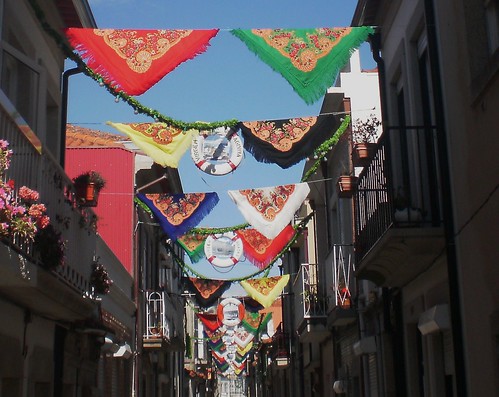
Rua enfeitada com os lenços de Viana
Popular festivities bedecked with regional scarves,  MNati Garrido
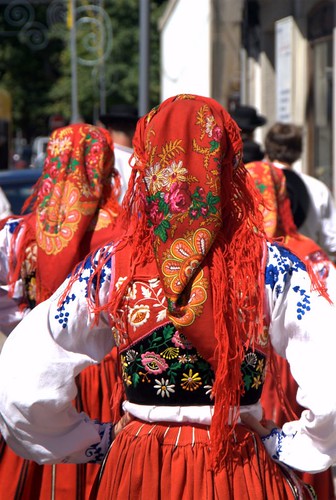
Traje
Viana do Castelo folk costumes, mvcaf

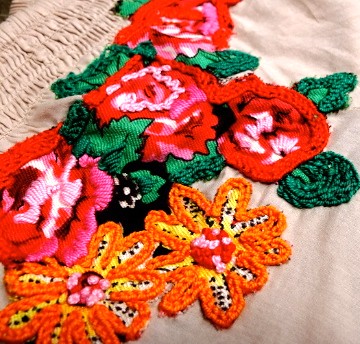
DSCF4874
Final work... My photo

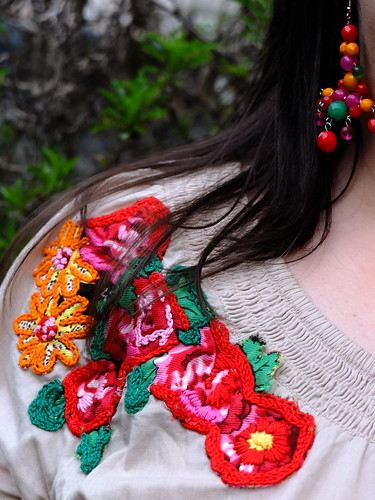
I cut out some motifs from the scarf that seemed to me appropriate to decorate the neckline of the dress.

DSCF4866
Embroidering... My photo
DSCF4882
Final work with the scarf already cut, my photo

DSCF4868
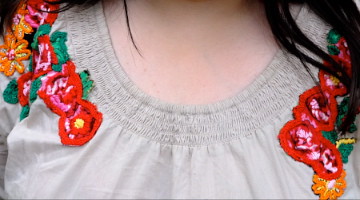
Both sides embroidered but not symmetrically, my photo
DSCF4873
With specially made earrings...  My photo


Stitches are not perfect but they were not intended to be perfect... I used chain stitch to go round the motives and fasten them to the dress. Some french knots, satin stitch and one or another "crazy stitch"... I hope you like my dress made of stitches with Portuguese soul...

Oh!!! Portuguese class was missing... Scarf means "lenço" and dress means "vestido"... Two words a girl needs to know!!
SITE DESIGN BY RYLEE BLAKE DESIGNS