Showing posts with label Viana embroidery. Show all posts

January 30, 2014

From Viana with love and cork

Olá! Today I'm continuing from last week's post showing the incredible work of Teresa, from Artesaté, that recreates the Portuguese traditional embroidery of Viana do Castelo, from the Minho region.

Tradition says that the embroiderer must use a cotton thread in blue, white and red. And Teresa uses blue, white and red... but the shining of Viana's jewelry inspired her to use gold, too..

Tradition says that the embroiderer must use cotton and linen fabrics... but the need of modernizing her work inspired Teresa to use felt and, lately, cork fabric, too...

Tradition says that the embroiderer must use hearts, japoneiras, oak leaves and clover leaves as motifs (among others)... but lately the embroiderers have forgotten the leaves... and Teresa, inspired by her wish of being faithful to the genuineness of Viana's embroidery and her permanent desire of knowing more and more, recovered the clover and oak leaves in her stitching, too.


Blue, red and white, the most traditional colors in Viana do Castelo Embroidery.


Teresa argues that the impressive presence of gold jewelry in her home city, Viana do Castelo, was the main influence on her choice of using metallic threads in her embroidery.

Born 100 years ago, the "modern" Embroidery of Viana do Castelo, suited for home linen, is now subject to a certification process that requires the respect of some rules which dictate the non use of golden thread. However, more than 100 years ago, the embroidery tradition was deeply rooted in this region, with a widespread use of wool yarn to embellish women's costumes: skirts, pouches and waistcoats. As you may confirm if you follow the links, this embroidery was profuse in the use of color, including metallic threads. Today these threads are not common, with the exception of their use in embroidered boxes, very popular in Viana do Castelo.


In gold, inspired by the rich jewelry.

The choice of the clover and oak leaves as well as the use of cork are the latest innovations in Teresa's work. And the photos I bring are very recent...

In the traditional embroidery from Viana do Castelo, clovers were popular patterns. Seventy or eighty years ago there were three and four-leaf clovers and their size varied greatly, but nowadays the clovers are rare and very small. In the past, the patterns inspired by nature were stylized by the embroiderers from the Minho region. Driven by emotion, while creating a clover, the embroiderer could not resist to draw it by the joining of three or more hearts, reinventing once and again the love pattern. And that's what we find on the last embroidered heart by Artesaté, that uses this lately recovered motif and the blue from Viana's ocean.


At the top the three-leaf clover, joining three hearts

It may sound unexpected but Teresa feels that Viana's embroidery and cork, being both famous symbols of Portugal, make a unique combination of textures and colors. It's natural that her words about the joy of embroidering on cork fabric may be overstated due to the excitement of a new love, but still they are worth being translated:

"It's a slow job that needs more attention. Stitches must be perfect at the first attempt, there is no space for errors once if you need to undo your stitching the cork fabric will be damaged. But the final work is special, more perfect, of a smoother texture to the touch and more rustic in appearance, which fits in perfectly with the tradition that I intend to transmit. The smell of cork fabric is one of the things that pleases and fascinates me the most, it spreads through the office making me feel that I'm working with nature and tradition."


In white, like tradition dictates... And recovering the oak leaf (at the top) forgotten in recent years.

Knowing how Teresa works, I'm already curious to see where this unique combination of tradition, innovation and love for Viana will take her...

April 26, 2012

My stitches have Portuguese soul

Olá! Last week I introduced you to Portugal and to our lovely stitches. Today I invite you to come and get to know my own “pontos*”. I’ll try to show why do I say they have a Portuguese soul, “alma Portuguesa”.

When I started to create my embroidery kits I was sure that would not suffer from lack of inspiration if I kept myself true to our traditions. And by traditions I don’t meant to narrow my inspiration to embroidery only… We have so many other inspiring features in our culture. Other crafts like pottery, tilling, basketry, jewelry, instruments making, lace work, weaving… Many genuine materials like cork, marble, linen and wool. And I could go on… And I will one of these days.

My first pattern was this Portuguese heart inspired by traditional Viana embroidery where the red and blue are the most usual colors and hearts a very common motif. So I reinvented it to make it easier for beginners… Some time after, I began embroidering the Portuguese heart using unlikely fabrics and floss colors. Do you think I’ve betrayed tradition? Even if I did it I kept myself true to Portuguese soul, and trust me, it is a very colourful one…

Traditional Viana embroidery, photo by Virgína Otten
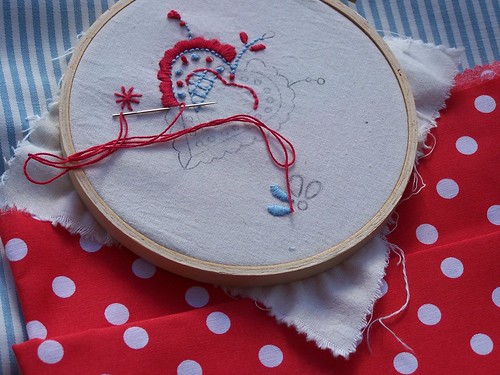
Portuguese heart - Coração de Viana
Portuguese heart pattern by agulha não pica 

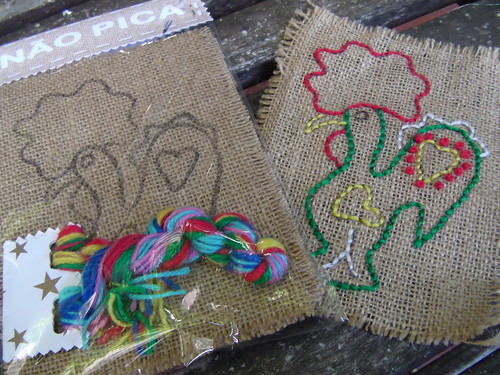
Creating embroidery kits for children was a big challenge… We all know that children love animals. It did not take me long to remember the most famous Portuguese animal: the rooster of Barcelos. Considered by many as our national symbol, I assure you that no visitor leaves our country without knowing it. The rooster that crowed after being dead is stamped on our fabrics, on old and new cloth, on modern accessories, on our walls and it is always present in our humour. Often bought as a souvenir, the ceramic painted rooster is not a good luck gift as many claim, but I confess I felt lucky with this pattern choice. Children can get to know our culture better and parents feel like they have a story to tell while children learn their first stitches. So here you have stitches inspired by ceramic and oral tradition… Do you agree this is an unexpected source of embroidery inspiration?

O Galo de Barcelos
Ceramic roosters of Barcelos, photo by Afton Halloran
Galo de Barcelos em serapilheira - Rooster of Barcelos in burlap
Burlap embroidery kit by agulha não pica

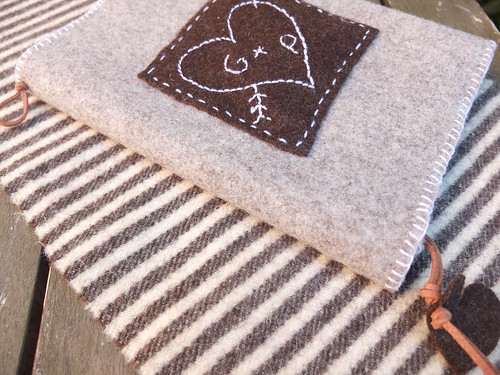
Last but not the least… When choosing the supplies for my kits I always have a strict principle: “Portuguese first”. It makes my work harder but I’m often surprised by my discoveries as happened with fantastic cotton floss, great wool yarn and very beautiful fabrics (I’ll talk about them in another post). Otherwise I would have to replace these products by foreign brands. Caught up in these findings I heard about burel, a 100% wool Portuguese fabric resembling felt, but more rustic. Burel, unlike felt, is a woven fabric and that makes it more resistant. It was used by mountain people and shepherds in capuchas, wool hoods that protected them from the cold. Recently I began working with burel to create “capuchas” for books and mugs. In other words, book covers and mug cozies kits. A piece of advice: embroidering on burel soon becomes an addiction…

Vilarinho-seco (128)
Capucha made of burel, photo by frproart
capucha para livros - burel book cover
Book cover kit made of burel, by agulha não pica

I hope my words showed you that I walk the talk when I say that my stitches have Portuguese soul…

Once again you’ve learned some Portuguese words… “Pontos” means stitches… “Alma portuguesa” means Portuguese soul… So you’ll have “pontos com alma portuguesa” for “stitches with Portuguese soul”…
SITE DESIGN BY RYLEE BLAKE DESIGNS