Showing posts with label burel. Show all posts

December 19, 2013

Christmas Star...

Olá! Passing by only to wish that the Christmas Star guides you, as it did with the Three Magi, to the true light...

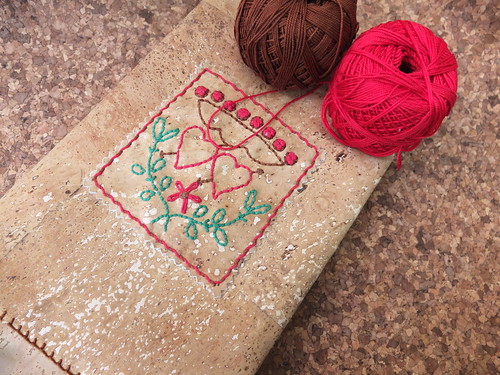
I bring you a beautiful star embroidered by my dear friend Inês and the words of a Portuguese poetess, Sophia de Mello Breyner...

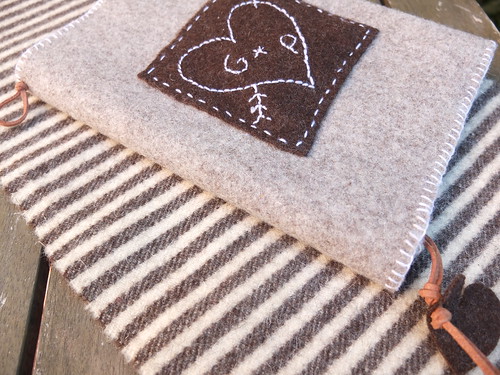
Inês embroidered on burel and cork fabric, our great traditional Portuguese materials. I'm amazed with her work because she didn't use a pattern to embroider, only the one she has in her head and her heart...

DSCF2955

'It was as if the brightness of a star had approached the Earth. It was Christmas" 
Sophia de Mello Breyner

Feliz Natal!

October 31, 2013

Celebrating St. Martin

Olá! Today I decided that next Saturday I'll participate in a craft show. I had nothing prepared and I needed to think of a very, very simple project inspired by the craft show theme: chestnuts... Yes... Chestnuts...

November is the month of the chestnut in Portugal. We celebrate St. Martin's Day preparing a magusto festivity. In that day you will find us eating roasted chestnuts and drinking água pé -(literal translation is "foot water") - a traditional and very mild alcoholic drink.

All this is stated by a a typical Portuguese saying:
É dia de São Martinho;
comem-se castanhas, prova-se o vinho.
(It is St. Martin's Day,
we'll eat chestnuts, we'll taste the wine.)

We will celebrate St Martin's day next 11th November and, as always, we expect very shinny days!! At that time the weather is always different from the other Autumn days... Very good and warm. That's why we call this period Verão de S. Martinho - St. Martin's Summer. The legend tells that on a very cold and rainy day Martin, a Roman soldier, cut off half of his cloak and offered one part to a beggar that was dying of the cold. Then the sun begun shinning, by God's intervention, and Martin was able to return home safely. All our children learn this legend at school!!

So... I needed a very easy project that could be made by someone that does not know how to embroider... Trying to find out what to do, I took a look at my working surface and I found my favorite materials: burel (a Portuguese felted wool) and cork. With them I knew I could create a chestnut!!! And the next step was, as I usually do, trying to find a simple pattern. As my drawing skills are terrible, usually I google images using words like "chestnut coloring"... And I always find very simple drawings that children use to color... Of course, in the end, I never make like the pattern I found, but  for me it is a very powerful inspiration source!!

So I had the materials and the pattern...

Burel and cork fabric - 100% Portuguese materials
Portuguese materials: cork fabric and burel
And decided to make a coaster using the chestnut pattern and Portuguese materials. But I made a mistake (not for the first time...) and it ended up very small... What a pity!! Next time I will make beautiful coasters to decorate my S. Martinho's table!!

DSCF2432
100% Portuguese chestnut
So, I had to think of something else... And I remembered of making something to decorate the table, maybe we can call it a centerpiece...
Using the same materials, I applied the chestnut into a burel piece and with a very thin cork strip I created a simple finishing all around.

Chestnut table decoration
Chestnut inspiration!!
It's not perfect but I believe it will be a good project for someone that does not know how to embroider and is not familiar with these materials... But I confess I would still prefer the chestnut coaster...

Did you know that these two colors of burel only use the natural colors of wool, no dying materials?

May 23, 2013

Girls' stitching

Olá! Continuing on last week's theme, Child's day celebration... I bring you this week an idea that you can try with girls, I would say girls older than 8 years old... I believe that at this age it's very important to choose projects that they can use in their daily life...

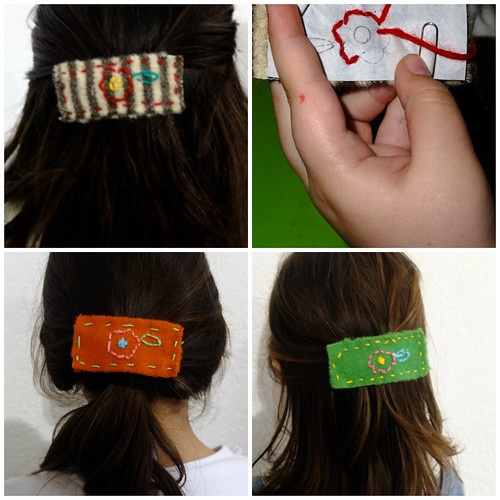
Last month I've coordinated a workshop with some girls and boys... The girls were all 9 years old and they told me they would love to make a hairpin! The boys were younger and not so enthusiastic about having a new hairpin. :)

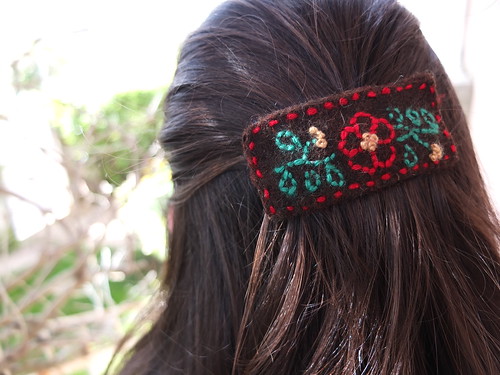
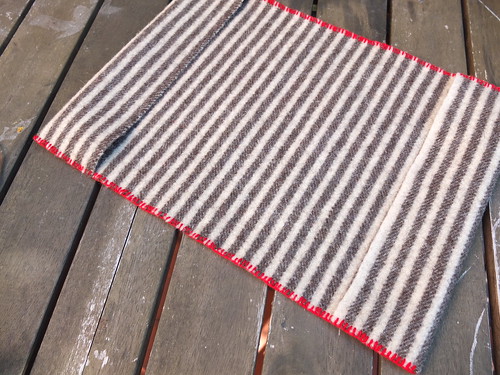
Some time ago I developed a kit to make an embroidered hairpin using, as always, Portuguese materials and patterns. I adapted motifs from this book and burel or cork fabric were the materials chosen. These are great materials, not only because they are Portuguese, but above all because they don't unravel, what makes them very easy to work with.


Hairpin made of burel
Embroidered hairpin in burel
With these girls I "re-adapted" the motifs, making them easier. The most difficult part was transferring the pattern. Burel is very similar to felt... I used the same technique as explained here, embroidering through both tracing paper and burel. I have to admit it was not too easy, but they managed to do it all by themselves.

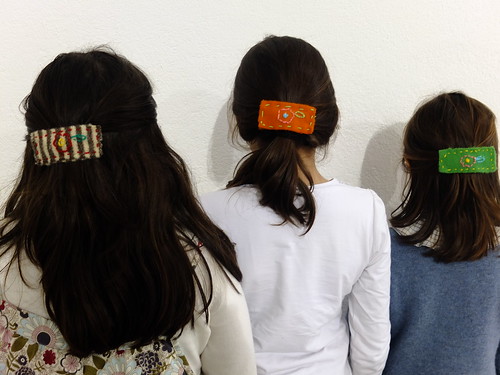
Proud of their hand embroidered hairpins
GIrls and their handmade hairpins
They were very proud with the results and all the color choices worked really well. Mothers loved the final work, too. You can't see their faces, but believe me, they were smiling!!

Girls and their handmade hairpins
Proud girls...
Last week I was with my younger daughter and we met one of these girls, I hadn't noticed, but my daughter told me: "she's using her hairpin"!!! 

I hope this can inspire you to make a project with your girls, and please let me know if they liked it!!!

December 20, 2012

Christmas Memories Notebook (with Portuguese soul)


Olá! This is my first Christmas in feeling stitchy and I never want to forget it... In fact, I believe that we should never forget each of our Christmas! And that was the reason why I decided that it would be great to have a Christmas memories notebook... Wouldn't you like to do the same?

Decorate a notebook as you like and use it to describe how special was your Christmas... Your Christmas Eve, the gifts you gave, the gifts you've received, the most special moments. Work with your children so they can have their memories notebooks, too. They'll love it!


Christmas notebook
Christmas memories notebook

Christmas craft notebook
Craft Christmas Memories notebook

My Christmas memories
Share your Christmas Memories

My Christmas Eve
Describe your Christmas Eve...
I promise that this will be a special Christmas, and it will remain in your memory forever...

* As always I've only used Portuguese supplies... The notebooks, wool yarn, cotton thread and my home made Christmas decorations with cork and burel... They all have a Portuguese soul!

Has anyone already wished you FELIZ NATAL? 

December 7, 2012

Picado - Appliqué embroidery from the Northeast of Portugal

Olá! Today I'll talk about a very specific type of needlework technique: "appliqué". I really don't know if it is rigorous to consider this technique as a type of embroidery, but in Portugal we do it. As I've already talked about, we find these embroideries in Nisa - Bordado de Aplicações (Appliqué embroidery) - and as you'll see today we also find them in the North of Portugal. There, in the north, this technique is called Picado (the best translation I find is "punched").


Picado work,  from here
I couldn't find too much about the historical perspective, but I decided to publish it anyway once the images talk by themselves and I truly love this type of embroidery. At the same time, and continuing last week theme, I believe it would be fun to show more embroidered pieces wear by men.

All the embroideries I will show come from Tras-os-Montes (behind the hills), a region in the Northeastern corner of the country. Facing a very hard climate and isolation, people that live "behind the hills" maintained many folklore forms preserved up to our days among which are included these embroideries on wool cloth, really needful in cold winter days. Burel, saragoça and surrobeco are the fabrics used, but distinguish from each other is not easy, once they are all made of wool.


Picado work,  from here
I believe the origin of this type of embroideries was the Capa de Honras (Cloak of Honours). Many consider it the most luxurious Portuguese costume. Traditionally they come for Miranda do Douro and are brown male cloaks with a pendant on the shoulders, open in the back and decorated with appliqué embroidery, Picado. It was worn by cattle keepers and shepherds to be protected in coldest days and by the wealthy men. It's a work of great complexity, taking 20 days to get done. A long time ago they took more than 60 days once all the decorations were hand trimmed and then hand sewed to attach the apliques to the cloak. 


Beautiful photo of a Capa de Honras, by Ana Rojas
The "honor" in the name does not refer to the fact of being used by noble people but instead to the fact of being so elaborated. There are still some artisans that dedicate their lifes to this art. Follow the link and you'll find a video about one of those tallented tailors, check and don't worry about not understanding Portuguese once the images of his work speak for themselves.
Nowadays Capas de Honra are used in important cerimonies. Recently, a renowned Portuguese stylist, Nuno Gama, brought them to his 2010/2011 winter collection and fashion show.

Another application of Picado are the charmimg decorated vests from Pauliteiros de Miranda. I would say they are one of the most original piece of Portuguese traditional outfits. And they gain increased beauty when we see the whole costume. 


Vest decorated with Picado, from Pauliteiros de Miranda
"Pauliteiros are the dancers of a Portuguese folklore dance, the warrior dance of Terras de Miranda, called “dança dos paus” (“the stick dance”), which represents local historical moments. It uses bagpipes, a snare drum and a bass drum, and it’s traditionally danced by eight men that wear a skirt and a linen shirt, a brown vest, leather boots, whool socks, a hat that can be decorated with flowers and finally, a pair of sticks that they use in a diverse series of steps and coordenated movements that simulate a fight." (1) 
Check here and see the beatiful photos of Pauliteiros de Miranda and again here to watch a performance.


Beautfiully decorated vests with the Picado technique, photo from here
Recently some artisans begun using the same technique with different applications, in home decoration, accessories, handbags, clothing...


Home decoration using Picado, photo for here
Home decoration using Picado, photo for here
Would you say that the Picado technique is a type of embroidery? I promised myself that soon I'll learn how to do it, and then I'll tell you!! The first lesson is here, but I will need many more.


September 20, 2012

Book cover tutorial with Portuguese soul

Olá! As asked by some of you, here you have a tutorial on how I make my book covers! Never forget that I only use Portuguese materials... So try your best to find some materials similar to these.

Making a book cover in burel or in cork skin (cork leather or cork fabric) is very simple ... Burel and cork skin, 100% Portuguese, are very beautiful and easy to work with because there is no need to finish edges since they won't unravel. This is very important, make sure you’ll use a fabric like these, so no sewing is needed!!!

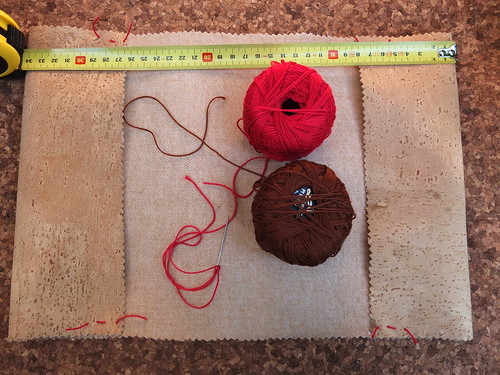
You should start by defining the size of the cover. From my “reviews” I found that the best dimensions are 34cm (13 1/3”) wide if you measure the cover when open and 24cm (9 1/2”) height. I tried many books and almost all fit this size. But maybe in other countries publishers use different book dimensions…

I advise you not only to see the photos but also click the links, they will help you and show you different solutions...

Material needed to make a cork fabric book cover
Everything you need to make your book cover
What will you need:
- a piece of fabric that does not unravel of 50cm (20”) wide by 24cm (9 1/2”) height;
- two more pieces of fabric that does not unravel: one piece of 11cm (4 1/3”) squared and another of 11cm by 8cm (3 1/7”) (if you are working with inches, you may try to find a similar size easier to measure…)
- 50 cm (20”) of suede cord (or another type, as you prefer);
- a needle;
- wool thread or cotton floss, depending on the fabric you’ll be using;
- tracing paper and a pattern;
- a pair of scissors with sharp points.

And that’s all!! Let’s begin…

1. Fold over the two outer edges of burel or cork skin to the required size and baste (two or three stitches will be enough) the four corners of the book cover, making two side pockets.
DSCF6633
Fold over two outer edges to the required size
2. Use blanket stitch to hold the outer edges and to finish the whole cover. Instead of blanket stitch sometimes I use whipped running stitch and I believe that running stitch would be great, too.

DSCF3619
Use blanket stitch to finish the whole cover and hold the outer edges.
3. Use the square piece of fabric to embroider a motif that will decorate your book cover. With this kind of fabrics transferring the motif it’s never the easiest part… I use tracing paper with the pattern and I hold paper and fabric together embroidering through both. Believe me it works better than you would think! At least, if you keep your patterns simple. I’ve already shown some photos in a previous post…

After embroidering the motif you must centre it on the front of the cover and use an appropriate stitch, like blanket stitch, running stitch or back stitch, to attach it to the cover. You can use the fabric without embroidering it, too. If you left the top open, you’ll have a pocket in your cover!!

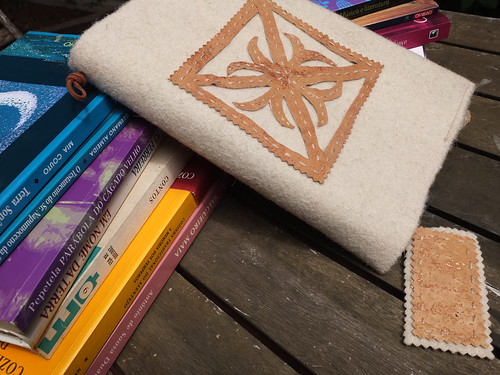
Embroidered cork fabric book cover
An embroidered cork fabric book cover.
4. Your book cover could be ready to go, but I love to add a book marker to it. Use the small piece of fabric left and choose a shape to your bookmark. You can embroider it or keep it simple… In order to finish the book marker, you must perforate the top of the book marker with a sharp-pointed scissors. Or, even more simple, punch holes at the top and bottom with a hole punch.  Then pass the two ends of the suede through the hole and, if necessary, pull them with the tip of the needle. Tie a knot with the two ends together to hold the cord to the piece of fabric. On the other side you will attach the suede cord to the book cover. Fold the cover in half and choose a point at the top to make a small hole with the scissors.
Perforating the cork fabric in order to attach the bookmarker
Perforating the book cover to attach the book marker.
Tie a knot so that the marker is secured to the cover as in the photo.
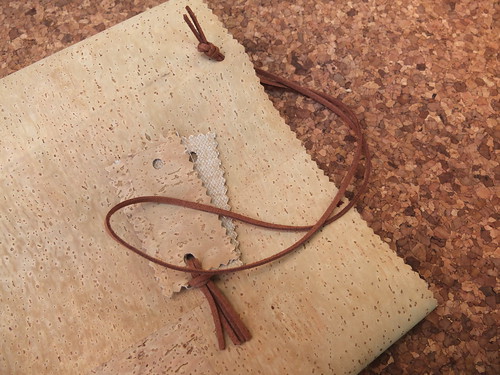
Very easy to make - cork fabric bookmarker
Attaching the book marker.
Your book cover is finished! These is a very simple way of doing it but the possibilities are almost infinite... They will depend on the fabrics, the threads, the colors... And, above all, it will depend on your imagination...

DSCF5590
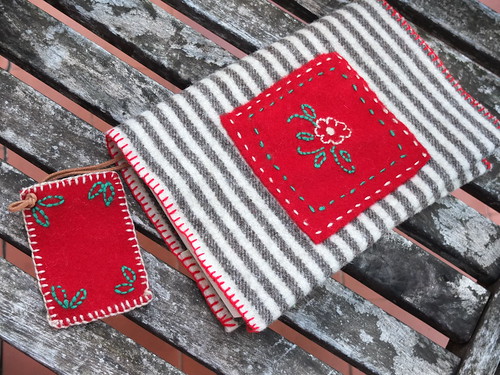
I love this book cover made of burel...
DSCF4392
"Burel" and cork, beautiful together...
I believe that when you are working with great materials, like burel and cork, they should be the stars and keeping it simple is always the best choice to make… Look here  and here to look at an even simpler way of doing it - a "four stitches" book cover... More simple is not possible!

You already know these words in Portuguese, but I don't mind repeating them... "Cortiça" for cork and "burel" - no translation available :)


May 10, 2012

Saudade

Olá! This week my Portuguese soul is full of “saudade"... Do you believe our stitches can talk about our feelings?
Do you? So let me say you that saudade is a word that, as far as we know, has no equivalent in other languages... A single word whose meaning is complex, of great depth and culturally significant. And one of the hardest to translate in the whole world…
Longing and nostalgia are commonly used to explain saudade... Saying that my heart is full of saudade means that I’m missing someone or something... But it’s far more than that... I believe that what “Portuguese soul” adds to this sentiment is a feeling that the return of that thing or person is unknowable and entirely left to fate...

Hearts in burel...
Embroidered on burel, my own simple stitches
Although identified in ancient documents since 13th Century, “according to some historians, this word came to life in the 15th Century when Portuguese ships sailed to Africa and Asia. A sadness was felt for those who departed in the long journeys to the unknown seas and disappeared in shipwrecks, died in battle, or simply never returned. Those who stayed behind -- the women, children and old folks -- deeply suffered from their absence. There was the constant feeling of absence, the sadness of something that was missing, the yearning for the presence of the loved ones who had sailed.” (1)

Embroidered necklace
Embroidered burel necklace, french knots with wool
This week I tried to choose some photos of my stitches that could talk about my feelings… I’m feeling sad… So I’m not in a colorful mood… But at the same time I feel strong and strangely warm… As if the pain of the loss was calmed and caressed by all the good memories and the confidence in a future gathering, which has just been delayed a while… As so the natural colors of wool and the rude softness of its texture are perfect to express these feelings...  Because saudade is natural, rude and soft too...
"The feeling is also sugar-coated, you remember it with a grin, laugh about the memories and your heart is filled with this great intoxicating feeling.”(2) "Although it relates to feelings of melancholy and fond memories of things, people and days gone by, it can be a rush of sadness coupled with a paradoxical joy derived from acceptance of fate and the hope of recovering or replacing what is lost by something that will either fill the emptiness or provide consolation".(2)

A Portuguese key ring...
Burel key ring, many hearts - one heart
I believe our stitches have the gift of speaking for us… And I hope that the stitches I’ve chosen can translate into images a word that has no translation…
Some say that the richness and uniqueness of language create realities and feelings... That would imply that only Portuguese people could feel saudade. I truly do not share it: The saudade felt by the lost of a great friend is as universal as friendship…

A final and I hope inspiring note... Wherever the Portuguese Language is spoken the word saudade is sung with different accents and rhythms… You can hear it in Portuguese from Portugal, from Cape Verde or from Brazil… I hope these songs maybe an inspiration for your stitches...

April 26, 2012

My stitches have Portuguese soul

Olá! Last week I introduced you to Portugal and to our lovely stitches. Today I invite you to come and get to know my own “pontos*”. I’ll try to show why do I say they have a Portuguese soul, “alma Portuguesa”.

When I started to create my embroidery kits I was sure that would not suffer from lack of inspiration if I kept myself true to our traditions. And by traditions I don’t meant to narrow my inspiration to embroidery only… We have so many other inspiring features in our culture. Other crafts like pottery, tilling, basketry, jewelry, instruments making, lace work, weaving… Many genuine materials like cork, marble, linen and wool. And I could go on… And I will one of these days.

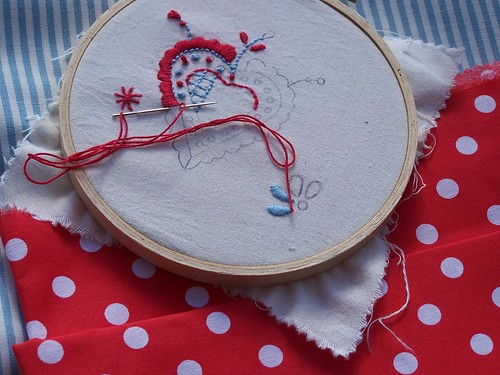
My first pattern was this Portuguese heart inspired by traditional Viana embroidery where the red and blue are the most usual colors and hearts a very common motif. So I reinvented it to make it easier for beginners… Some time after, I began embroidering the Portuguese heart using unlikely fabrics and floss colors. Do you think I’ve betrayed tradition? Even if I did it I kept myself true to Portuguese soul, and trust me, it is a very colourful one…

Traditional Viana embroidery, photo by Virgína Otten
Portuguese heart - Coração de Viana
Portuguese heart pattern by agulha não pica 

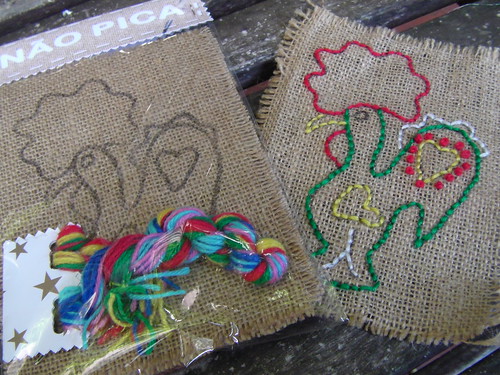
Creating embroidery kits for children was a big challenge… We all know that children love animals. It did not take me long to remember the most famous Portuguese animal: the rooster of Barcelos. Considered by many as our national symbol, I assure you that no visitor leaves our country without knowing it. The rooster that crowed after being dead is stamped on our fabrics, on old and new cloth, on modern accessories, on our walls and it is always present in our humour. Often bought as a souvenir, the ceramic painted rooster is not a good luck gift as many claim, but I confess I felt lucky with this pattern choice. Children can get to know our culture better and parents feel like they have a story to tell while children learn their first stitches. So here you have stitches inspired by ceramic and oral tradition… Do you agree this is an unexpected source of embroidery inspiration?

O Galo de Barcelos
Ceramic roosters of Barcelos, photo by Afton Halloran
Galo de Barcelos em serapilheira - Rooster of Barcelos in burlap
Burlap embroidery kit by agulha não pica

Last but not the least… When choosing the supplies for my kits I always have a strict principle: “Portuguese first”. It makes my work harder but I’m often surprised by my discoveries as happened with fantastic cotton floss, great wool yarn and very beautiful fabrics (I’ll talk about them in another post). Otherwise I would have to replace these products by foreign brands. Caught up in these findings I heard about burel, a 100% wool Portuguese fabric resembling felt, but more rustic. Burel, unlike felt, is a woven fabric and that makes it more resistant. It was used by mountain people and shepherds in capuchas, wool hoods that protected them from the cold. Recently I began working with burel to create “capuchas” for books and mugs. In other words, book covers and mug cozies kits. A piece of advice: embroidering on burel soon becomes an addiction…

Vilarinho-seco (128)
Capucha made of burel, photo by frproart
capucha para livros - burel book cover
Book cover kit made of burel, by agulha não pica

I hope my words showed you that I walk the talk when I say that my stitches have Portuguese soul…

Once again you’ve learned some Portuguese words… “Pontos” means stitches… “Alma portuguesa” means Portuguese soul… So you’ll have “pontos com alma portuguesa” for “stitches with Portuguese soul”…
SITE DESIGN BY RYLEE BLAKE DESIGNS