Showing posts with label historical. Show all posts

December 1, 2015

Magna Carta (An Embroidery)


British artist, Cornelia Parker has produced a 13 metre-long embroidery of the Magna Carta Wikipedia page to celebrate the document's 800th anniversary.


“I love the idea of taking something digital and making it into an analogue, hand-crafted thing” says Cornelia Parker. Due to the evolving nature of Wikipedia the artist chose last year's version of the page as a basis for her work, fixing this version in a tangible form.


This epic embroidery incorporates contributions from over 200 people. The majority of the text was stitched by prisoners which was lead by the social enterprise Fine Cell Work. Hand & Lock, the Royal School of Needlework and the British Embroiderers' Guild were also major contributors.


Many other individuals were invited to embroider a few words including judges, lawyers, civil rights campaigners, members of parliament, artists and musicians. “I thought carefully about the words they should stitch. For instance, Baroness Warsi, Eliza Manningham-Buller, Julian Assange and numerous prisoners have all stitched the word ‘freedom’, but all have different relationships to it.”


“I wanted the embroidery to raise questions about where we are now with the principles laid down in the Magna Carta, and about the challenges to all kinds of freedoms that we face in the digital age. Like a Wikipedia article, this embroidery is multi-authored and full of many different voices. ”

The work is currently on tour across the UK.


August 27, 2012

Sources, Sources and the joy of more Sources

Hullo! Before we move on to start another project, I would like to share with you where I go look for my sources on-line as someone had asked in the comments awhile back.

When I began, I downloaded most of the embroidery books from Project Guttenberg. Eventually I moved on to the Antique Pattern Library, and well, I am still stuck on this site for there is just so much of everything here! But in the days where I get too overwhelmed there, I pop into the Embroidery Archives of the University of Arizona, or find some gems in Google books, or searching embroidery on the Internet Archives. And I must include The Little Grey Bungalow blog even though it has just a few embroidery titles, for it always puts a smile on my face with all the public domain gems she finds!

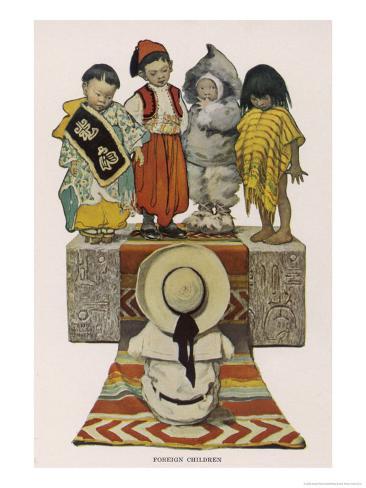
But the best source discovery so far is from Feeling Stitchy reader Cathy! She found where our little children from the doll quilt project came from!!
She shared that it is an illustration by Jessie Willcox Smith and the original link she sent is from Pennelainer's flickr, where it describes it as coming from "A Child's Garden of Verses" by Robert Louis Stevenson. And thanks to Cathy, we now know that the 4 kids are "Little Japanee, Little Turk, Little Eskimo and Little Indian" from the curious poem called "Foreign Children"!

How wonderful this place called the Internet! :-) I hope you all continue to leave comments and share here on Feeling Stitchy, it is such a lovely surprise when one thing leads to another!

Now I must prepare for the next little project! I will be making the pattern this week for an adorable play apron from Priscilla Embroidery Patterns so I will be able to share it with you next Monday. It comes from a catalog so there are no instructions or pattern, but this photo looks promising :-).


Until then, have a happy week everyone and enjoy getting lost in the embroidery of the past!

January 21, 2011

Schoolgirl Embroidery

This is a bit of a break away from the colorful, non-traditional and whimsical stitching we all love here on Feeling Stitchy, but I thought this would be of interest.

The Florence Griswold Museum is currently displaying (only until January 30th!) an exhibition called "With Needle and Brush: Schoolgirl Embroidery of the Connecticut River Valley"

The Connecticut River Valley was one of the most important centers in America for the teaching and production of embroidered pictures by girls and young women in private academies during the late eighteenth and early nineteenth centuries. As the first exhibition to examine the subject of Connecticut River Valley needlework in depth, With Needle and Brush contributes to the understanding of the traditions of needlework and provides insight into the nature of women’s schooling before the advent of widespread public education. Guest-curated by needlework experts Carol and Stephen Huber, this exhibition of approximately seventy embroideries, watercolor sketches, and portraits will draw extensively on works from private collections, many never before shown publicly.

I love the example above- which I think is a "mourning embroidery". If any of our readers are in Old Lyme, Connecticut and have a chance to see this, let us know about it!

Link

May 15, 2007

Sources of Inspiration - The Göss Vestments

The Göss Vestments are a set of three eccesiastical garments which date to the 13th Century. They were sewn in silk on a linen ground using a variety of counted stitch techniques including brick stitch, stem stitch and a type of basket stitch. Vestments represent an ensemble of stylistically matching liturgical garments, for the priest, deacon and sub-deacon, supplemented by a festive altar cloth. They are currently held and on display at the Museum für Angewandte Kunst (Museum of Applied Arts) in Vienna.

For extremely close up images of these vestments, visit the Rubens Art Server. (Be sure to NOT use the panorama viewer, you get much more detailed shots if you look at the images directly). Be prepared, there are lots of images (60 odd with amazing detail, you can count how many thread stitches are done over) and they are large (over 1 mb each).

Again, please note, there are swastika motifs on this work.

An example of how you can use elements of the patterns found in these items is at An Innocent Abroad where we have a nice pin cushion based on the vestments.

May 8, 2007

Book Review: "Here By Wyverns: Hundreds of Patterns Graphed from Medieval Sources" by Nancy Spies

Title: Here Be Wyverns: Hundreds of Patterns Graphed from Medieval Sources
While this book is aimed at people interested in historical patterns, it would also be enjoyed by anyone with a love for fantasy, animals or border designs. All the patterns in the book have been converted to cross stitch graphs. The graphs are in black and white and very easy to read.

The book itself is divided into several chapters:
  • Imaginary Creatures - dragons, basilisks, harpy, drollery, pheonix, wyvern etc
  • Animals - bunnies, badger, hedgehog, bear, butterfly, snail, fox, lion, bull etc
  • Water Creatures - fish, seahorse, mermaid, merman etc
  • Architecture - castles, towers, tent, cathederal etc
  • Birds - peacock, generic birds, eagle, goose, owl, pelican etc
  • People - man on horse, marching men, guard, saints, knights, groups, musicians etc
  • Lettering - Gothic Textura Quadrata, futhark, Irish Half Unical etc
  • Overall Designs - geometric patterns, florals, trees, birds, hearts, stars etc
  • Borders - divided into several sub chapters by period (6th-11thC, 12thC, 13th-14thC, 15th-16thC) repeating geometric, animals, hearts etc
  • Odds and Ends - large single patterns, block motifs, keys, knots, boats, celestial etc
The book gives a good range of difficulty in the patterns, there are very simple borders that could be completed quickly by a beginner to much more complicated pictorial and border designs that would challenge the more experienced cross stitcher. Also, many of the patterns, particularly the borders, could also be used for tablet weaving, knitting, patchwork, beading or needlepoint.

The book is 192 pages long, with four pages of colour plates showing some of the designs stitched up (something from just about each category is represented in this section). The book is spiral bound.

While there is no complete acknowledgements section to find where each pattern was sourced from, the original type of source (stained glass, embroidery, goldwork, carving), date and rough location is given so that most can be related to the original piece with a bit of research.

Also, think about visiting the website (click on cover above) there are several pages from the book to look at.

Why I Bought the Book

I am always interested in books that have patterns based on historical work. I liked this one cause it had some simple little motifs that I could use for quick projects and also more indepth patterns, such as the borders that I could use as a basis for decorating cloths (in my case, I would convert the designs back to free form embroidery, which in most cases is more appropriate for clothing).

Details:
  • "Here by Wyverns: Hundreds of Patterns Graphed from Medieval Sources" by Nancy Spies
  • Softcover: 192 pages including 4 colour plates
  • Publisher: Arelate Studio (2002)
  • ISBN: 0-9718960-0-3

May 7, 2007

Samplers

An embroidery sampler is defined as an example to be followed. Samplers are exactly what they sound like they would be, examples of different stitches. Historians say samplers started as a way of depicting events or stories in history and gradually the alphabet, motifs, and symbols were added. During the 19th century samplers became very important to the education of young girls in the preparation of their future roles of wives and homemakers. I can't say that samplers are made for those reasons today but luckily they are still stitched and making embroidery history.


How to Make an Embroidery Sampler:

1. Study sample designs in books, museums, internet sources, and antique stores.

2. Collect embroidery patterns for motifs, verses, or alphabets you hope to include.

3. Combine elements. Draw a chart of your overall design.

4. Select fabrics, thread colors, and stitches.

5. Embroider your sampler and include your signature.

(provided by eHow)

There are many styles of samplers being stitched today from the traditional sampler on the left made by Jennifer of moving hands. . .


Boredom Make You Do Crazy Things


. . . to the witty sampler made on the right by flickr member, artg33k.


primitive sampler cushion

And of course the beautiful redwork sampler made by the ever popular, Redwork in Germany.


-----------------------------------------------
* For examples and patterns of primitive samplers check out the selection at Chestnut Junction.
* Here is a list of books all about samplers from Amazon.
* And if you are looking for free patterns, Vintage Transfer Finds has motifs and alphabet letters just for you.

May 1, 2007

Sources of Inspiration - Textile Arts of Central Asia

I like my embroidery to be practical and Central Asian embroidery is very practical. Many examples of this type of embroidery are on everyday objects, from doors, to pouches, to clothes. Some great examples are found at the site, To Have and To Hold. This is an exhibition by The New England Rug Society. This exhibition displays a large collection of Central Asian embroidered bags.

The following site also looks at bags from Central Asia - LAKAI The Bad Beys of Central Asia again looks at bags, while Turkoman Embroidery and Women's Magic looks at a variety of objects created by Turkoman women, it specifically looks at only a single element of their embroidery tradition, the protective and magical functions of embroidery in birth, childhood and marriage.

The Renaissance Tailor has a great tutorial on how to make a central asian hat for winter and some examples of very bright embroidery for decorating them.

This site, Textile Arts of Central Asia, is a site at the Powerhouse Museum, set up to help Year 12 HSC (Higher School Certificate) students with their studies.

April 17, 2007

Book Review: "Art of Embroidery" by Lanto Synge


This week I've decided to do a quick review of Art of Embroidery: History of Style and Technique by Lanto Synge. This is the type of book that acts as a corner stone to a good specialized collection.

This is a new work, a descendent of his earlier work Antique Needlework published almost 20 years ago. Lanto Synge has had a long association with the Royal School of Needlework in London, so has had access to an extensive collection of needlework, both old and new. This access shows in the depth of styles and techniques covered in this book. This is an historical survey of embroidery through history and not a how-to book.

The book is arranged chronologically, beginning with a general introduction, then moving onto early needlework, Medieval, post-Medieval periods and then by century to the present day. There are side chapters on specific aspects of needlework, of particular interest to me is the chapter on Heraldic embroidery. There are also sections on costume, furniture, Chinese and Indian work.

Each chapter looks at the major stylistic movements of the time and puts embroidery within this as well as wider political, social, economic and religious contexts. For example the impact of the Reformation on embroidery was huge, due to the fact that the Church had always been a major customer for and receiver of commissioned embroidery works. There were also major stylistic changes in the designs and techniques used.

The vast majority of the illustrations are colour, with only a few black and white. There are images on almost every one of the 352 pages, with most having more than one image, in addition there are several full page images which give greater detail of selected pieces (there are even images in the bibliography and index!). In addition to the text and images, there are informative end notes (useful for further research), a 4 page glossary, bibliography, acknowledges for images and finally an index.

For those like myself with an interest in pre-17th century embroidery, a bit more detail. The chapters covering early, medieval, post-medieval and heraldic embroidery take up approximately 78 pages. Images of interest include: full page image of Coptic roundal (silk on linen), full page image of 13th Century German chasuble (good illustration of typical Germanic motifs used for many centurys), 12th Century English mitres (images in black and white), variety of 14th and 15th Century copes - Pienza, Bologna, Syon and Steeple Ashton Copes, mourning cape with heraldic design, 16th Century tent stitch French bed valances and great examples of various uses of heraldic display in embroidery.

Why I Bought the book

My training and passion is history. I love it and that is reflected in my embroidery. My focus is historical styles and techniques. Because of where I live, I don't have access to any historical works in person, so I rely on books. So when a book like this one comes out, it goes to the top of my lust list. This book has lots of info and pics about a period that doesn't get covered much except in highly specialised books or journals or out of print works that I can't access.

As far as an "Aaahh" moment, it was seeing a whole chapter dedicated to heraldic embroidery. I am involved in the SCA and one of the main applications for embroidery in that context is in heraldic display in various forms. So any book that shows use of embroidery for heraldic display is going to get my attention!

So it was a combination of the above that finally pushed this one over the line. Don't get me wrong. I had to visit the book several times at the book shop before I bought it, but it is a solid bit of historical writing and that is something I am always interested in. On the whole my taste tends to run to about books, not how-to books. I tend to design my own stuff, and I like to be historically accurate as possible, so this sort of book is important in giving me data on which to base my own work.

Even if you don't specialise in historical embroidery, there are so many great images and information that it's bound to give everyone inspiration for their own work.

Details:
  • "Art of Embroidery: History of Style and Technique" by Lanto Synge
  • Hardcover: 352 pages ; Dimensions (in inches): 1.29 x 11.26 x 9.04
  • Publisher: Antique Collectors Club; (July 2001)
  • ISBN: 185149359X
  • Cost: $120AU or about $100US

April 3, 2007

Opus Teutonicum


NOTE: A word of warning about one design element common in medieval design including embroidery - the fylfot or more commonly, the swastika. This form of broken cross is a very common cross design used throughout Europe in the Middle Ages. It had religious, not political meaning and you might come across it while looking at examples of medieval embroidery.

Opus Teutonicum (or German work) is the name given to the style of whitework embroidery popular in German lands, especially Lower Saxony produced during the 12th, 13th and 14th Centuries. This style of plain, whitework embroidery stood in contrast to the golds and silks of Opus Anglicanum. It has been theorised that Opus Teutonicum developed because of the cost associated working with silks and gold thread. However, these simpler materials do not detract from the artistry and impact of the whitework embroidery.

The production of this type of embroidery is often associated with the convents and other religious houses of the period. Many fine examples of Opus Teutonicum survive today. One of the best collections is at the Kloster Lüne. Opus Teutonicum items were used in churchs as altar cloths, Lenten veils, frontals and hangings for lecterns.

In the 13th Century, linen was a popular ground for much embroidery work and was used in conjunction with white linen thread to produce the works. There was small use of light coloured silks to make highlights on figures. By the second half of the century, the use of coloured silks increased. There were exceptions to this, with the work produced at Kloster Lüne worked entirely in linen with no use of silk.


By the 14th Century, there was also an increase in the inclusion of secular motifs in the works. These included non-religious human figures and animals and birds, as well as increasing use of heraldic elements.

Although most numerous in Lower Saxony other areas also produced Opus Teutonicum works, including Hesse and Westphalia. Those in Westphalia were almost exclusively for lectern hangings, which produced embroideries of up to 4 m (13ft).


A variety of techniques were used in German whitework, one involved filling figural or abstract designs with complex geometric patterns created in satin or brick stitches. This added texture to the overall design. Another stylistic stream found in Opus Teutonicum is where robust stitches such as buttonhole stitch are used to outline a design. The interior is left plain but the areas outside the outlining stitch are made into a net like design using pulled thread techniques.

Some further images of Opus Teutonicum:

March 27, 2007

Sources of Inspiration - Museums

Needleworkers are always looking for sources of inspiration. The advent of the Web has opened a whole new world to needleworkers when it comes to finding new and exciting examples of needlework to inspire future projects.

A great source of inspiration for new projects is to look to the past. There are fantastic textile and needlework collections held in museums around the world. Many of the big museums and an increasing number of the small ones, are making their collections available online. The quality of the online collections vary greatly, but even the smallest image can be an inspiration.

This pouch is based on an example in the Victoria and Albert Museum. It is from the 14th Century, from the Westphalia region of Germany and is made using silk thread on evenweave linen in brick stitch.

When searching online databases, finding something depend on the search term you use. There are two ways to do it, by broad category:
  • embroidery
  • embroidered
  • needlework
  • textile
  • fancy work
or by technique:
  • blackwork
  • redwork
  • cross-stitch
  • needlepoint
  • petit-point
  • sampler
  • klosterstitch
  • opus anglicanum
  • goldwork
Most museums and galleries have a separate section for their Collections. If it is possible to search in the Collections, rather than the whole site, do so, as you will generally get a better set of search results.

So here are some links to various online catalogues and databases associated with museums around the world:
And now since this is my first post, a little about me. My online name is Laren but I also use Jane which is my name in the SCA. The SCA is a historical recreation society. My main area of interest and activity in the SCA is historical embroidery, so I will be posting about that. This will include articles about historical embroidery techniques, history of popular embroidery stitches and techniques, examples of surviving historical embroidery and anything else that takes my fancy! I am slave to two kitties and live in Newcastle, NSW in Australia.

My main blog is The Needles Excellency, and a couple of websites In Prayse of the Needle, where I have project diaries, handouts with patterns etc and Historical Needlework Resources, which has lots of links to information about historical embroidery and examples of surviving historical embroidery. My Flickr site. My current project is based on a 14th Century German klosterstitch wallhanging which will probably take me about 400 hours to complete.
SITE DESIGN BY RYLEE BLAKE DESIGNS