Showing posts with label interview. Show all posts

June 8, 2017

Craft With Conscience Series by Sarah K. Benning

Original embroidery by Michelle Kingdom, featured by Sarah K. Benning in the series Craft With Conscience

I am blown away by the latest interview of Michelle Kingdom on Sarah K. Benning's site - her work is so consistently innovative and breathtakingly beautiful and daring. I also had the honor of interviewing Michelle for our blog - here is that post.

The interview with Michelle is part of a larger series called Craft With Conscience - in Sarah's own words:

"This series arose out of my own frustrations related to seeing my work constantly copied stitch-for-stitch, sold without permission, and credited to other people. Rather than wallowing in unproductive negative emotions, I wanted to find a way to bring this common issue to light in a positive way. My solution was to share the work of artists, crafters, designers, and makers who I greatly admire for their originality and dedication."

I love the idea of using a negative experience as inspiration to share something positive and inspiring with the world. Definitely an idea I come back to, again and again, and my main source of inspiration as I write my posts for Feeling Stitchy.

I highly recommend a visit to Sarah K. Benning's site, and the Michelle Kingdom interview!

Hi, I'm floresita, editor of Feeling Stitchy. I'm an avid stitcher, knitter, and crafter. You can see more of my stitching on Instagram and my blog. My vintage transfer collection is on Vintage Transfer Finds.

Feel free to email me with any ideas for the blog!

June 28, 2016

Katrina Majkut - In Control


The fantastically innovative artist Katrina Majkut joins us to discuss her work and specifically her latest embroidery collection entitled 'In Control'. Katrina talks about her inspirations and work processes as well as the powerful message that she expresses and transfers through her work and the incredible impression and response it evokes.

What led you to the medium of thread and embroidery art? Was there a defining moment for you?
I was living in Berkeley, California from 2009 to 2011 and all around me was the birth of many modern activist movements: Black Lives Matter, marriage equality, Obama was pushing for free birth control, Occupy. I was also starting TheFeministBride.com and doing a lot of research into wedding tradition and how many Western social practices define women’s identity and set their status in society, which really helped me understand how embroidery did the same. I was also bound for grad school and very bored by store-bought, mass-produced cross-stitches so I started experimenting.

When did you learn to embroider?
I was around ten years old. Like most young girls, I learned from my mother.


How does embroidery best translate your idea and vision?
Embroidery as a domestic craft has almost always been a way to assert specific feminine values and identities – for example, what it means to be a woman, a mother and a wife, but it never included the physical components many use to fulfill those roles. I began to wonder whether that omission had contributed to so many social and civil politics that refused to give women full reproductive rights or even acknowledge that basic need, so I started stitching all products related to women’s reproduction, bodies and health. In doing so, my artwork is often characterized as subversive, which is insane because the reality is these health products and needs are natural and common for the majority of women. Someone once called me “brave” for doing this work, which was a compliment that caught me off guard because it’s so basic to me - it’s part of everyday life, but for me to connect the idea of bodily autonomy with women’s roles has been considered radical. There’s absolutely no reason why this should be the case.


How does feminism inform your art in particular your embroidery collection entitled 'In Control'?
The collection would not exist without feminism. Feminism is the tool that enabled me to understand how women’s health is treated in respect to social practices and equality. It also empowered me to modernize the sexism embedded in embroidery in a constructive, educational and bipartisan way. It also gave me the confidence to do this project despite the fear that it might be considered controversial; it’s a great support system. Feminism is just the means to achieving social, economic and civil equality between men and women; healthy and comprehensive access to widespread reproductive rights is crucial for that to happen. I don’t think that equality is possible if we don’t address where the inequality lies in all social and civil systems, and that includes embroidery. How can equality be possible if everyday practices, even something seemingly benign ones like stitching, reinforce obsolete gender roles and inequity?

Do you sketch your designs before you commence your embroideries? Could you tell us more about your creative working process and how you develop your idea into the final piece?
As a classically trained painter, I use observational painting techniques to create my cross-stitches. That means I essentially look at the object and translate it visually directly with needle and thread. There’s no computer program to turn the image into a stitching map and I seldom draw the object on the fabric (drawing on the fabric muddies up the final image). I will draw curves sometimes so I get the angle correct the first time, but it’s very minimal. I use a grid book to block text though as it’s more efficient to do so and helps to prevent spacing mistakes and material problems. Using observational painting techniques also lends itself to more accurate still life drawing; a computer program too often reduces the complex colors in an object to the point of color blocking. Being familiar with color theory immensely helps realistically render an object. As a result of my personal methods, I’ve taught myself new techniques in cross-stitch that include color layering through half stitches, texturing and color gradation.


Is there a particular style of embroidery that you prefer?
Definitely cross-stitch, though I’m currently learning drawn thread via traditional Ukrainian techniques, which is awesome because I’m simultaneously learning about my heritage.

Who and what influences and inspires you?
I’m really inspired by the women (and men) who see my artwork and feel confident and comfortable enough to share their own personal stories or thoughts with me. It’s something I had not anticipated happening with my artwork. So many will share what it was like to get an abortion or have a miscarriage or go through menopause or grow up in a household/school that ignored basic health knowledge and will share how that hurt them as adults, etc. These are experiences that get too often silenced in the public despite being common occurrences. For them to feel strong enough to share these stories with me or the art patron next to them (who they also don’t know) is just so powerful and inspiring. And sometimes the stories are not always easy to listen to, but it’s taught me a lot about patience, listening, empathy, kindness and how necessary lessons like these are for everyone.


Which other artists do you appreciate?
My favorite artists tend to be painters since that’s where my formal art training lies and with painters that attempt to modernize historical art tropes by including modern social and civil issues – Mickalene Thomas, Kehinde Willey, Swoon. As far as embroidery artists, Elaine Reicheck was really the first one that got the wheels turning for me, though to me, her work is much more about the Mechanics of Reproduction (Walter Benjamin) and breaking away from the domestic and gendered hand of embroidery, whereas I think the power of my work lies in connecting the handmade with ideas about bodily autonomy. Cayce Zavaglia is really an inspiration too when thinking about how thread can function like paint.


Can you tell us about the impact that your art has on the audience and what responses you receive about your work?
I’ve been very lucky in that most patrons have been extremely supportive. Once in awhile, I get the question of why would I bother to make this work, why does it matter and why should it matter to the viewer; to which I have to backtrack to basic ideas about civility and understanding other people’s needs outside one’s own and how art is a good platform for increasing this understanding. I think taking a strong bipartisan, medical (I consult with doctors, etc. on accurate representation) and educational objective helps a lot in quelling those who might not like or oppose my chosen topic. The series doesn’t just focus on one aspect of reproductive rights, like birth control or abortion as is common in a lot of feminist reproductive art; I think it’s more useful to show how those two things are connected to less controversial things like disease prevention, menstruation, pregnancy, etc.

Since I’m constantly working on creating a more intersectional perspective of needed products, I get a lot of thanks from certain demographics, who want to be represented but often feel like they are excluded – baby boomers are particularly vocal! Though sometimes people often (constructively) highlight demographics or perspectives that I’ve missed, and I’m eternally grateful when they do that because my point of view as a cis, heterosexual woman is limited. Because they were brave enough to speak up, my series becomes better rounded, humbling and inclusive, my perspective is not the only one that matters. That’s why I included essays in my In Control catalogue from women who offer a diverse personal and professional perspective regarding health and reproductive rights – I hope to get more essays over time and build out the catalogue.

Do you have any upcoming exhibitions, workshops or lectures?
Yes, at Hollister Gallery at Babson College in Wellesley, Massachusetts this fall! Opening reception and artist talk is October 27 from 5-7pm and the show closes December 21, 2016. I’ll also be exhibiting at Bloomburg University in Pennsylvania in the spring of 2018. Anyone can also check out my artwork here.

August 8, 2015

Interview with Lynn Harrigan

I am fascinated by the daily calendar stitching of fiber artist Lynn Harrigan - known on Flickr as Obliquepoet. All year, I have seen the loveliest daily stitches of her calendar as it slowly takes shape - and there is something so beautiful in following along with her daily process.

Lynn was kind enuogh to answer some brief questions on her art, skills, and inspiration for our readers - please read on to learn more about Lynn's fascinating art...

July calendar by Lynn Harrigan


How did you learn to embroider? Are you self-taught?
I began embroidering in June 2007 and spent the rest of the summer that year learning stitches and experimenting with the effects of stitching on different kinds of cloth. Later, I took an eco-printing workshop with India Flint and learned some natural dyeing techniques to create interesting grounds for my embroidered images.

Is there a particular style of embroidery or embroiderers that appeal to you most?
I appreciate a variety of contemporary embroidery styles, from abstract textural work to figurative pieces. I also love the narrative element in the work of embroidery artists Michelle Kingdom and Iviva Olenik.


Cicada Shoreline by Lynn Harrigan
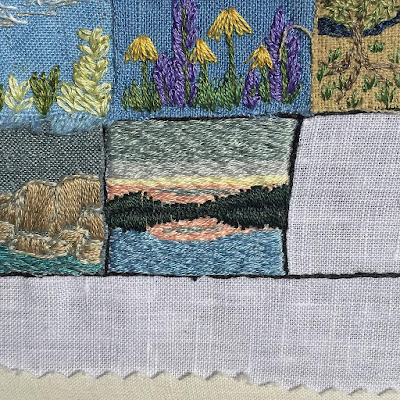
"Cicada Shoreline" from "Aqua Reliquia - Shorelines" 
eco-printing + embroidery


July 29 by Lynn Harrigan
July 29


What inspires you to embroider?
The Great Lakes region inspires most of my embroidery. I was born in Clinton, Ontario and raised on a farm near Lake Huron, one of the Great Lakes. Growing up on the Central Huron coastline and now living in Toronto on the shore of Lake Ontario, the ecology of the Great Lakes region continues to be my main source of inspiration.

How much time does it take to complete each square in your calendar? Do you sketch your pieces before you embroider?
It takes between 2-4 hours to complete each calendar square, although a few have taken up to 6 hours to complete. Mostly I work from a photograph I've taken that day or a sketch in my journal.


Lake Huron Shoreline by Lynn Harrigan
"Lake Huron Shoreline" from "Aqua Reliquia - 1913"


April 18


You are also a poet and a writer - do you also keep a journal?
I use my journal to record the day's weather and sunrise/sunset times as well as to capture and explore ideas for the "Calendar Project".

Do you have favorite authors, or writers you feel are significant to you and your work?
Alice Munroe's stories are set in Huron County, the area where I grew up. She captures the physical and emotional landscapes of the region with such poignancy. A more direct inspiration is the Group of Seven, especially their paintings of the Georgian Bay area.


Fall Shoreline by Lynn Harrigan
"Fall Shoreline" from "Aqua Reliquia - Shorelines"


 March 22


Do you have a studio space or special room you create in? If so (or if not) what would you consider your ideal space for embroidery?
My ideal space for embroidery is sitting outside beside a lake or surrounded by trees, but I most often work at home on the couch with a daylight magnifying lamp.

You mentioned a fascinating collaboration between you and your partner, Scott M2 that is a fusion of your embroidery and his music - do you have an example you could share with our readers?
My partner, Scott M2, and I collaborated on "Aqua Reliquia - 1913", an art installation mounted in a Toronto gallery in the fall of 2013. Based on the events of the Great Storm of 1913, "Aqua Reliquia - 1913" featured my fiber art and poetry plus Scott's video art and electronic soundscapes by his band, dreamSTATE:


Aqua Reliquia by Lynn Harrigan
"Aqua Reliquia - 1913" at Gallery 1313, Toronto


Do you exhibit or sell your work?
I have exhibited and sold a number of pieces over the years. Several of the pieces from Aqua Reliquia - 1913 sold during the show as well as other unrelated pieces exhibited during group shows. More information about the installation, and my other projects, is available at www.lynnharrigan.com.


March calendar by Lynn Harrigan


Thank you, Lynn, for sharing your time and talent with us! Follow Lynn's calendar project daily on Instagram and Flickr.

For an in-depth interview on Lynn's process, don't miss the wonderful interview by Olisa Corcoran on MrXStitch - Inspired to Stitch: Lynn Harrigan.

Hi, I'm floresita, editor of Feeling Stitchy. I'm an avid stitcher, knitter, and crafter. You can see more of my stitching on Instagram and my blog. My vintage transfer collection is on Vintage Transfer Finds.

Feel free to email me with any ideas for the blog!

July 25, 2015

Interview with Katya

Today, I have the pleasure to introduce you to Katya, a Ukrainian artist whose beautiful embroidery projects I stumbled onto on Flickr. Her lovely "sketchbooks" are filled with embroidery sketches as detailed and lovely as drawings or paintings. Let's meet Katya!

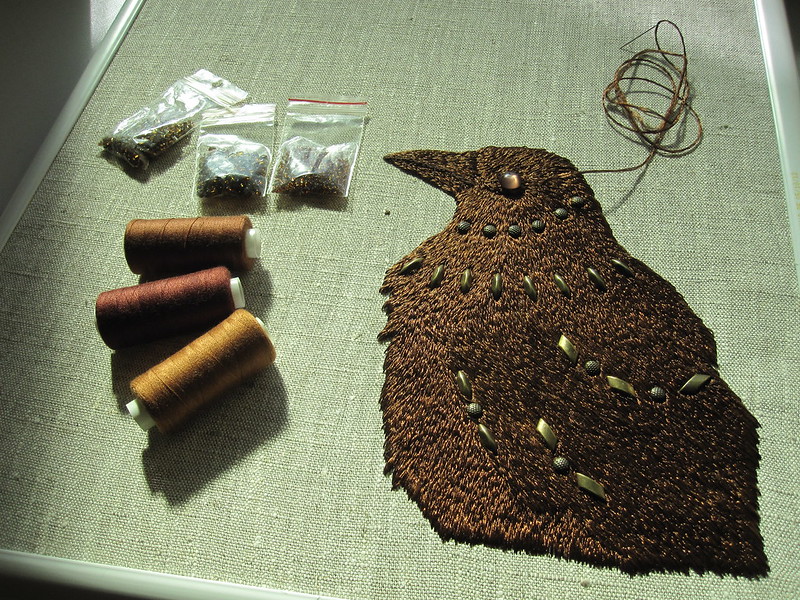
The Raven in progress

How did you learn to embroider? Are you self-taught?

My Grandma loved to sew and mend things. Her name was Evdokia. She tried to engage me in different crafty activities but I was hopeless as a kid, and lazy :). Though I guess I was always surrounded by people who loved creating handmade things and about 4 years ago I started my first project (it was a simple cross stitch kit).

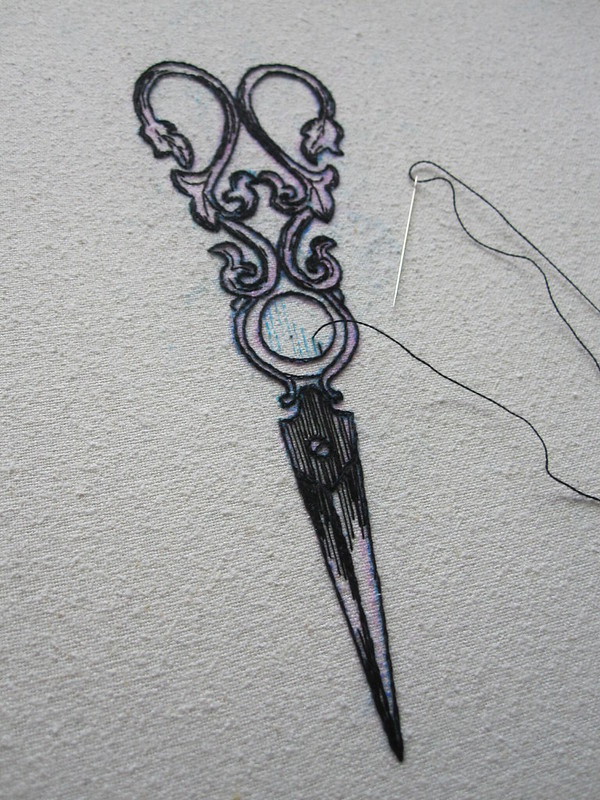
Antique Scissors II


Is there a particular style of embroidery or embroiderers that appeal to you most?

My dream is to master gold work and luneville (or tambour) embroidery. This autumn I’m planning on a visiting a local school of embroidery that offers these courses.

I am a big fan of embroidery done by Michele Carragher. She is creating amazing pieces for different TV series. She always inspires to learn more and apply different techniques. Right now I’m working on the project "The Raven" that was inspired by Michele’s works and by Game of Thrones. Honestly, I do not know when I will finish it. Ideas keep coming during the work :).

What inspires you to embroider?

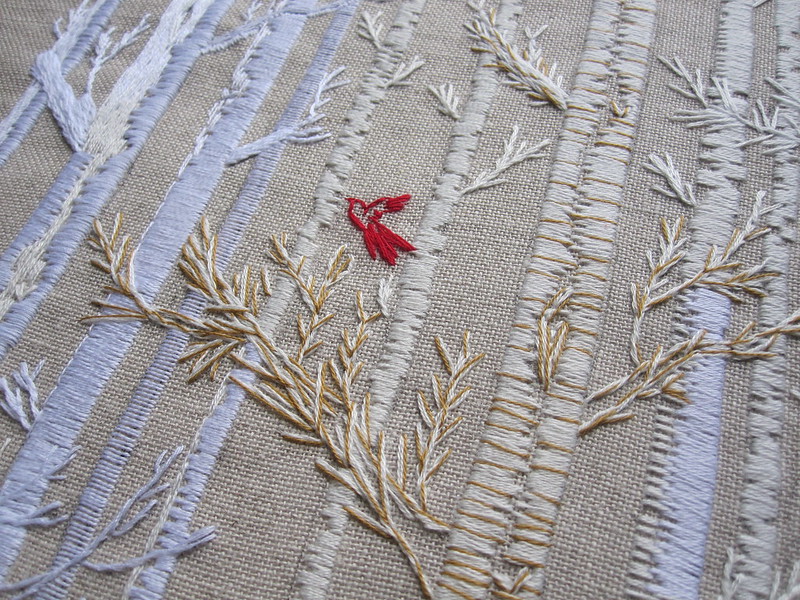
Inspiration comes from different places. It can be a creepy TV series like Hannibal, or wallpaper prints with an interesting design of the forest. Lately, I’m into birds and everything related to birds :).

Woods


Do you do your work in a studio or special place? Do you think your surroundings are important to your process?

I do not have a studio. But of course as any craft person I wish I had one. I work at home. It’s a sunny place (that’s very important to me since I like working with lots of daylight). I have lots of cases, chests and boxes to store threads, needles, beads, fabric. The surroundings are important but I can embroider anywhere :) (while waiting for the train or when I have a break at work).

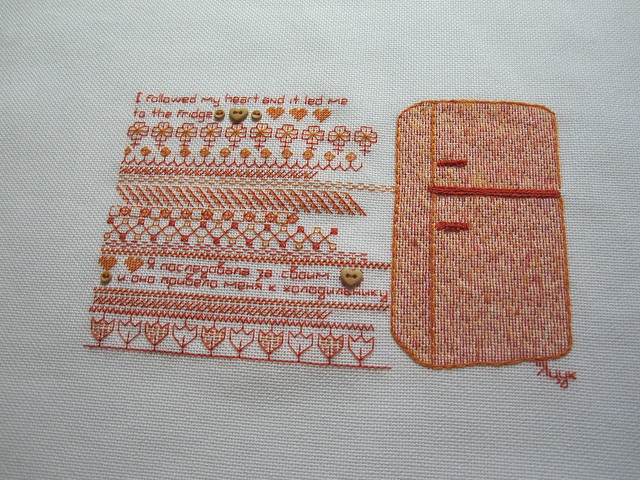
I followed my heart and it led me to the fridge

Do you sketch, paint, or do any other artistic pursuit?

Sometimes I sketch but usually I work with the illustrations and photographs I find on the web. I love creating collages. The latest project: fairy-tale characters living in a modern city.


If you could meet any other artist, embroiderer, or crafter, who would you like to meet?

I would really love to meet Michele Carragher :). Also, it will be fun to visit Royal School of Needlework in the UK.

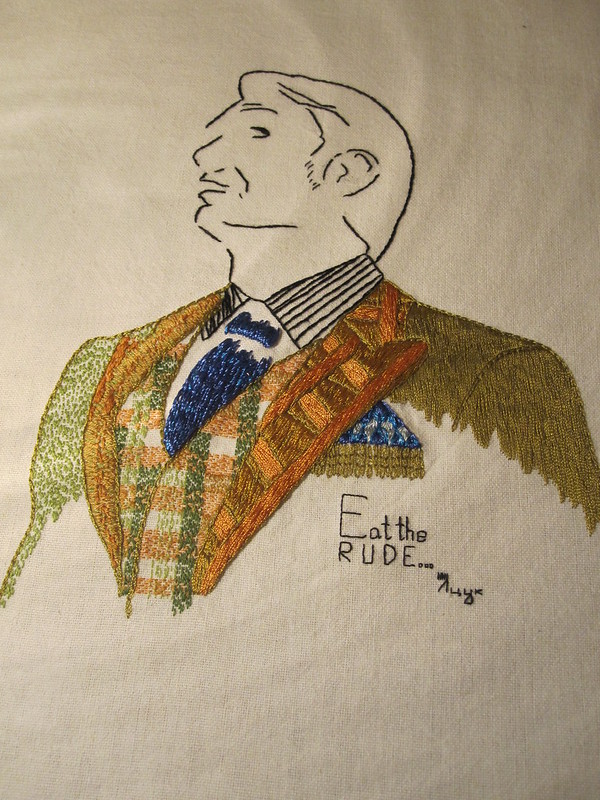
Hannibal Lecter.  Eat the rude.

Do you enjoy any other “crafty” pursuits like knitting, quilting, etc.?

I like sewing little things like pouches and textile brooches. Though many of them are not finished yet. That’s the problem – I jump from one project to another :).

Do you exhibit your work, have a shop, or sell your work in any way?

In a week I’m planning to participate in a charity fair dedicated to helping people with HIV. And I don’t have problems with choosing presents for my friends’ birthdays. I do not have a shop but I’m thinking about opening an online shop.


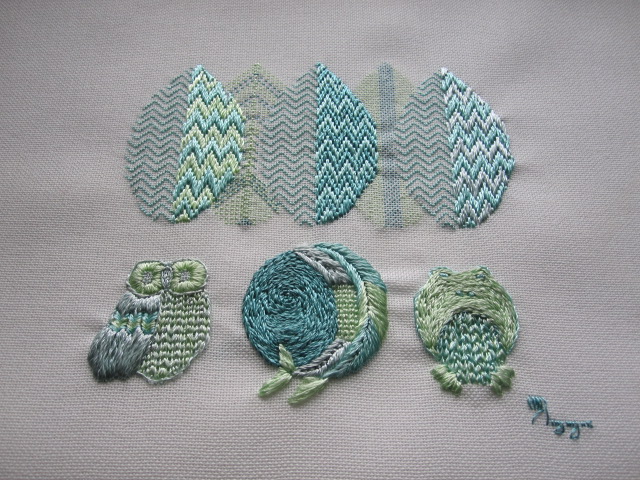
Untitled

For more on Katya, visit her Flickr stream.

Thank you for this view into your world and art, Katya!

Hi, I'm floresita, editor of Feeling Stitchy. I'm an avid stitcher, knitter, and crafter. You can see more of my stitching on Instagram and my blog. My vintage transfer collection is on Vintage Transfer Finds.

Feel free to email me with any ideas for the blog!

July 18, 2015

Interview with Janet Bolton and giveaway!

Today I have the pleasure to bring you another guest interview done by Karen Thiesen. Karen interviewed Janet Bolton, who will be teaching a workshop in Santa Fe, New Mexico in September 2016. For more information on Janet's upcoming class, go to www.womanwithaneedle.com. Karen will also be giving away one copy of Janet's latest book to one lucky Feeling Stitchy reader!

Without further ado, let's meet Janet Bolton!

“The Kite Festival” by Janet Bolton

Who are your favorite artists?
This is a difficult question to answer but one that I am often asked. Recently I went to see a new exhibition of Eric Ravilious, an artist whose work I have loved for many years. His use of pattern and disregard of naturalistic perspective pleases me very much; maybe of course, because it relates to the way I compose my own pieces. But it is much more than this. There is a calmness and an Englishness that pleases me immensely, and I can remember seeing his work from my childhood. Another artist, not very well known, is Mary Newcomb. Mary lived in Norfolk and painted her surroundings in an idiosyncratic way. Often her starting point was a particular range of colours, for example, the colours of a misty morning. Painting a canvas to explore these observations, she would often keep them and decide what to place on them at a later date, another working method that I often use myself.

Winifred Nicholson is another favourite, her joy was to paint light. She often used flowers as her subjects to enable her to do this. I appreciate the way she worked in and appreciated a domestic setting.

Alfred Wallis, a retired sailor, painted, he said, in later life to keep himself company. I love the way he places the different elements of his images and his uncomplicated direct approach, painting with household paint on anything he had to hand.

I could go on and on but must mention Elizabeth Allen, a retired seamstress who also worked with the materials she had to hand. In this case fabric, and it was seeing her work, by chance, that confirmed my decision to work with fabric rather than paint. (Janet talks a bit more about Elizabeth Allen in her new book... see below).

Bits and pieces in the studio


Janet Bolton in her studio

What is the best part about working in your studio?

The best aspect of working in my studio is that I am surrounded by all the inspirational bits and pieces, not to mention the fabrics, that I have collected (knowing that I would use them sometime) over the years, Everything is to hand and sometimes chance 'sightings' and juxtapositions can change the direction of a piece that I am working on completely, very exciting. The room is light and airy so pleasant to be in. Having said this, I do use the whole house as a studio but love the knowledge that I am never far away from “the mother ship”.

Objects as starting points. “The Strange Plant” by Janet Bolton


Do you like working in other mediums besides needle and thread?
Drawing, sketching, making small watercolour and crayon studies, and making small objects from bits and pieces go hand in hand with my needlework. Very rarely do I relate these to my fabric compositions; just occasionally an object has become a starting point for a textile piece.


Janet’s latest work, “Cool Waters”

What is inspiring your current work?
This is another difficult question as I never know from day to day what will inspire me or how a piece of work will develop. I work around themes but these subject matters can be returned to years apart, some I think will go on for as long as I do. At this very moment it is very warm here and I am working on a very pale cool abstract piece. Maybe I am doing what the Japanese do, work on, or wear, cool colours when it is hot, and use a warmer palette when it is cool. Who knows, I have only just thought of this, and maybe it is just because the weather is unusually hot here at the moment.


Janet’s favorite work, “Barn on the Moors” by Janet Bolton


Do you have a favorite piece of work that you made?

My favourite piece is one I made many years ago, a landscape depicting a moorland scene. The fabrics used were dyed using plants from the area, and it brings back so many happy memories. (Janet talks about this piece in more detail in her new book... see below) I do have other favourites and one of the characteristics that they have in common is that they bring back good memories.


“Three Sheep Above the Mill” by Janet Bolton


You’ve taught and exhibited all over the world. What are your favorite places to visit?

It is a strange thing but having taught all over the world it becomes more and more obvious to me that is the people you meet in very diverse situations that are the important factor. As people travel all over the world from one venue to another, the groups are often made up of people from many different countries. It seems to me that textile enthusiasts are a great group of people and we often find that we have many things in common, no matter where we come from or what our personal backgrounds and circumstances are. This makes the world seem quite a small place. The venues that I go to are so diverse that it is impossible to select a particular one. I have been going for many years to Cowslip Workshops in Cornwall, a favourite destination; a beautiful venue, but also the owners have become firm friends of mine. West Dean College is another favourite place and yet quite different from Cowslip, so as you can imagine I find it almost impossible to compare places.


“Looking Up the Valley” by Janet Bolton


Thank you, Karen, for your wonderful interview with Janet Bolton! Janet will be teaching a workshop in Santa Fe, New Mexico in September 2016. For more information visit www.womanwithaneedle.com For more information on Janet, go to www.JanetBolton.com.

In honor of Janet's upcoming workshop, Karen is giving away one copy of Janet's new book, Fabric Pictures: A Workshop with Janet Bolton - Creating a Textile Story today on Feeling Stitchy!

Karen says about Janet's book:
It’s the next best thing to being in a workshop with Janet. It’s full of beautiful pictures of her work. My favorite one is “Catherine and Ali’s Wedding Day” made by Janet for her son and daughter-in-law. She used a piece of fabric from her daughter-in-law’s wedding dress as well as fabric from her mother’s wedding headdress. It’s just gorgeous.

Janet walks you through where to begin, how to do it, and how to finish your work. Looking at all the pictures is inspiration enough for me to want to get started. If you don’t have any of Janet’s books, or if you have them all (like me!) you will love this book.


To win, leave a comment on this post by July 20, 9 PM US CST, and answer this simple (or difficult) question - who is YOUR favorite artist? They can be any artist - embroiderer, seamstress, designer, etc! This giveaway is open to all of our readers - including our international ones!

Hi, I'm floresita, editor of Feeling Stitchy. I'm an avid stitcher, knitter, and crafter. You can see more of my stitching on Instagram and my blog. My vintage transfer collection is on Vintage Transfer Finds.

Feel free to email me with any ideas for the blog!

July 11, 2015

Interview with Michelle Kingdom

I am very honored today to bring you an interview with artist Michelle Kingdom - an incredibly creative embroiderer whose work I have admired for a very long time. There's something so mysterious and lyrical and gorgeous about her work - read on, then, to meet Michelle!

They could feel themselves shining in the dark


How did you learn to embroider? Are you self-taught?

I am a self-taught embroiderer, though I grew up surrounded by crafts and sewing. My background is in fine art with a particular interest in drawing. My loves for fiber and art ran parallel for a long time, but I eventually started to merge the two, essentially drawing with thread. When I first started embroidering I used regular sewing thread and basic hand stitching. Then I referred to an old 1970's "Reader's Digest Guide To Needlework" books, which I still have and use. I adore beautiful technique and fine embroidery, but prefer expressive stitching in my own work. The challenge of making interesting marks, especially curves out of tiny stitches fascinates me.


Little by little there was scarcely anything left


Is there a particular style of embroidery that appeals to you most?

I am a huge fan of all historical and ethnic textiles. The delicacy and understated palette of ancient textile fragments, the vibrancy and graphic design of folk costume, the awkwardly poignant stories in colonial "school girl" needlework, the simplicity and nostalgia of twentieth century house linens, and most of all the dense, rich fantastical worlds stitched in Stuart embroideries are all among my favorites.

Do you sketch all your pieces before you embroider them? Do you see your embroidery as sketches or paintings done in thread perhaps?

Yes, everything is sketched ahead of time, though I use the drawings as a skeletal framework that will continue to evolve during the stitching process. I almost never have a complete image in my head that must be executed exactly. In fact, I don't think I would bother to stitch at all if that was the case. I enjoy the surprises and detours each embroidery takes along the way, and how the narrative takes on its own life. I do see my work as drawings in thread, mostly because of my process and the similarity to sketching. It is never my intention to make my work imitate drawing or painting though.


back to my work - nearly done
In progress - Duties of gossamer


Is there a reason you embroider your works at such a small scale?

I do prefer to work on a small scale for a number of reasons, the most important being my overall vision. The content of my work is an exploration of private, even secret, thoughts, fears, hopes and dreams. This inner world feels best represented in an intimate way. Working on a small scale portrays the fragility and vulnerability I prefer, more like a whisper rather than a shout. I also make small embroideries simply for aesthetic and practical reasons.


Thick and knotted with the lives they had lived


You are an admirer of literature - do you also keep a journal and write?

No, but I do have several sketchbooks for images and literary snippets filled with ideas for future embroideries.

Your work is also very poetic to me - do you have a favorite poem or poet?

I don't have a favorite poet but I do have favorite writers that influence my work, most notably Virginia Woolf, Carson McCullers, Leo Tolstoy, and Hans Christian Andersen.


How cloudy the glass had become


If you had to make a choice between expressing your ideas visually or in words, would you be able to? Your pieces have such a lovely relationship to each other, both visually and verbally, in the titles you give them.

I appreciate your comment because I find words to be terribly frustrating. It is much easier to express my ideas visually and if I had to choose there would be no contest - visually would win every time. A lot of time is spent on the title because I hope the added layer of words will enrich the image and crystallize my own concept. Sometimes the title does come first, and inspires the visual piece. Overall my work is a collage of ideas, visuals and words, and pieced together they create a larger story.


The years fell and grew into vines


Aside from embroidery - do you enjoy any other “crafty” pursuits like knitting, sewing, quilting, etc?

These days I am more interested in embroidery but in the past I have dabbled in sewing, weaving, knitting and many other forms of craft.

Do you exhibit your work, have a shop, or sell your work in any way?

My embroideries are exhibited in galleries and I do sell my work. Some already framed pieces are listed at michellekingdom.bigcartel.com but others are available through direct inquiry on my website michellekingdom.com. I also do commission work as well.

***

Thank you Michelle, for your thoughtful responses and a glimpse of your creative work. For more on Michelle, don't miss this wonderful post about Michelle on MrXStitch to see more of her process and gorgeous photos of her sketches.

Hi, I'm floresita, editor of Feeling Stitchy. I'm an avid stitcher, knitter, and crafter. You can see more of my stitching on Instagram and my blog. My vintage transfer collection is on Vintage Transfer Finds.

Feel free to email me with any ideas for the blog!

June 24, 2015

Interview with Julie Sarloutte on El Blog de DMC


There's a fabulous interview with embroidery artist Julie Sarloutte over on the Spanish DMC blog, El Blog de DMC.

If you're not a Spanish reader, enjoy this handy English translation, from Google Translate:
Interview with Julie Sarloutte in English.

Hi, I'm floresita, editor of Feeling Stitchy. I'm an avid stitcher, knitter, and crafter. You can see more of my stitching on Instagram and my blog. My vintage transfer collection is on Vintage Transfer Finds.

Feel free to email me with any ideas for the blog!

April 11, 2015

Interview with Jessie Chorley - and brooch giveaway!

Once again, I am so pleased to bring you an interview by Karen Thiesen from www.womanwithaneedle.com - today, Karen interviews London-based artist Jessie Chorley. Jessie will be teaching a workshop in Santa Fe, New Mexico from September 15-19, 2015. Jessie also handcrafted a gorgeous brooch to giveaway today! 

Read on to learn more about Jessie Chorley, her art, her studio, and her inspiration.


You work with both paper and fabric. Do you prefer one over the other?
I would honestly say I find both incredibly inspiring to work with, I could not choose. I constantly work combining both together as I love the strength of the more robust fabric against fragile papers. I am an obsessive collector of both found paper and fabric but I do like to use my collections. I have a small selection that I refer back to for inspiration but a lot of what I collect I really do use up at quite a pace.

This is why I love having my shop as it gives me the opportunity to collect and pass these things on with a new life and a new beginning. To see some one walk away with one of my Altered Journals, for example, is like a completion to the story. My home is not crammed full of my collections but quite ordered. I love to display some things in my home for a certain amount of time and then they may head down to the shop or to the studio if needed for a particular commission.


What was the inspiration for your hand stitched souvenir hankies?
My current Souvenir Hankies were inspired by a workshop I was invited to run as part of the wedding dress exhibition here in London at the Victoria and Albert Museum. I was asked to base the workshop on one piece from the exhibition and I chose a hand printed paper souvenir napkin from the 1920’s.

I was so inspired by this particular piece from the exhibition, so have carried on making my own version of the souvenir hankie. I always use found and old hankies to re work into, adding simple scenes and words and sometimes incorporating simple block print. I have just created two for a couple for their wedding day.


How have you become the artist you are today?
Determination and a love for making! A lot of hard work and a passion for making. I love to make things so much and now that I teach others my skills as well I find this very rewarding. You need to be quite rounded as an individual to be a maker and shop owner, as running a shop and a business as a maker is very full time. You are constantly surrounded by your own world and the things you make. So having time out and being inspired constantly is also very important, otherwise the love for what you do will float away. I also have many friends who are makers, painters and artists who also have the same life style as me and will go to the end of the line for their own work. And these people are a great inspiration to me.

Being the maker I am today is a lifestyle that I have embraced. I have seen so many people that started in a similar way to me destroy their passion and love for making or being creative as they soon have tried to make things quicker and mass produce things. Then you just end up being behind a computer and your hands never get dirty or touch the "materials" again. I knew this was not a way that I wanted to go and always stayed well away from large wholesale orders and commissions and concentrated on smaller and more rewarding commissions and projects and also teaching my skills to like-minded others.


My workshops are now a large part of my business and always run just by me, which I think is important as a maker, as teaching others actually feeds back and inspires me as a maker. I feel so lucky for all the wonderful and inspiring people and friends that I have met from running my shop and from running my workshops and are now a large part of my world. My main passion still today after 10 years is "making" and I know deep down this will never change. But still one person can only make a certain amount, so over the last 3 years I have slowly developed a range of items that I get made locally either in London or in the UK. These items like my rubber stamps, screen printed tea towels and some greeting cards then come back to my studio and I finish them by packing them in my particular style.

I have never had any business training but I have always had a huge passion for that side of the business. Running the books and paperwork I really love doing as do I like the daily jobs at the shop and I guess it gives me a sense of control overall. When I give my years paper work to my accountant at the end of a year and she confirms all is well this is a great feeling. I am very practical as a person so I love the daily running of a shop and this also inspires my work. The two go hand in hand, and on Sundays, when my shop is full of customers appreciating my work, again, this is so rewarding and inspiring.


Since a very young age I was obsessed by having my own shop, but at the same time, I knew especially in London that would be a big jump. So since graduating from Goldsmiths College in 2005, I have worked alongside friend and fellow designer Buddug, and because there was the two of us we started the shop together. And now in July this year, after 10 years of our collaboration, I am taking over the shop on my own. For Buddug, her family and Wales has called her back but for me, London, especially Columbia Road and the shop is only just starting.

So this summer I am having a 10 years anniversary party on August the 15th and also on this date I will be launching my new book that I am currently working on "Jessie Chorley: Story of a maker". It will also be available online from August the 15th on my web site www.jessiechorley.com and will record mainly visually the last 10 years of my world as a maker.

My upcoming and newly laid out shop will also be the main hub for my London based workshops as I now do lots of one on one workshop sessions and also small groups here in London, so to have everything in one place, my shop and studio and workshops, will be great. Embracing social media and selling online has also really helped me become the maker I am today. Most of my online sales I send to the States and to Australia. My blog, www.jessiechorleyinspirations.com and my Instagram feed, not to mention my shop on Columbia Road, are my main source of advertising and I meet and work with so many other creative individuals because of these sources.

What is your favorite thing that you've ever made?
A salmon pink poem dress. I originally bought the dress from Spitafields antiques market here in East London and I hand embroidered a poem inspired by an Angela Carter novel around the neck. I kept the piece for about 6 years and exhibited it widely until it was bought by a store in Tokyo. I still have many photos of it and have since made a new version on a bright 1930s yellow dress.


What is your studio like? What's the most important tool you have there?
My studio is currently within a large old factory building out in Hackney Wick. So it is very tucked away and very organised but can also be quite messy, this is what I love about my studio. I often go. There is my work apron and I enjoy getting completely involved, painting, frames, paper mache are all things I enjoy doing here. The studio is quite isolating so I tend to make creative decisions here but then I prefer to do my Embroidery work when at my shop or at home. I get to my studio early in the morning and work fast and then often head to open the shop later on and finish work there. I only have 3 months left in my current studio as in July I am moving my studio to the back of my shop so my current studio is about to be packed up and lots of sorting to be completed before the move happens.


Do you have any special rituals while you're working?
Lots of tea and I love always to listen to music later in the day and Radio 4 first thing is a must. I never do any computer based work in my studio as this breaks my creativity and mood.


You have said you are very inspired by The Museum of Childhood in London. What is your favorite exhibit in there?
That is a hard one as there are many. But I am always drawn by a 1930 piece that is a collection of small dolls slightly squeezed into a glass fronted box. It was a personal piece from someone’s home. The box is covered in old green torn paper with a gold tint. What most inspires me about this piece is the way that the box is actually made from an old cupboard drawer with a glass frame attached to the front.


You were homeschooled in Wales by your mother, artist Primmy Chorley. What is the best thing you learned from her?
"Small is beautiful". This is how I run my business today, keeping things small but keeping the passion. Her love of collecting and making is deeply embedded in me as a maker not only in my work but also in the way I run my home.

*****

To follow Jessie's story, shop online, and view her upcoming workshop dates, visit www.jessiechorley.com.  Jessie will be teaching her first workshop ever in the US in Santa Fe, New Mexico, September 15-19, 2015 - details can be found at www.womanwithaneedle.com.

Thank you so much to Karen Thiesen, for providing this wonderful interview, and thank you to Jessie Chorley for a wonderful glimpse into your life as an artist, and your process!

Now, for an exciting giveaway - Jessie has created one of her signature brooches as a giveaway for one very lucky Feeling Stitchy reader! This giveaway is open to all of our readers.


To win Jessie's beautiful handmade brooch - simply leave a comment on this post by 9 PM US CST on Monday, April 13 - and answer this question: If you could have a studio to embroider, make art, and craft in - what would your dream studio look like?

Hi, I'm floresita, editor of Feeling Stitchy. I'm an avid stitcher, knitter, and crafter. You can see more of my stitching on Instagram and my blog. My vintage transfer collection is on Vintage Transfer Finds.

Feel free to email me with any ideas for the blog!

March 14, 2015

Interview with Rosalind Wyatt - and giveaway!

I am delighted today to bring you an interview with artist Rosalind Wyatt by Karen Thiesen from www.womanwithaneedle.com. Rosalind will be teaching a workshop in Santa Fe, New Mexico from May 11-17, 2015. Karen will also be giving away a copy of Leanne Prain's Strange Material: Storytelling through Textiles today to celebrate! 

Get comfortable, grap a cup of tea or coffee, and read on to learn more about the fascinating art of Rosalind Wyatt!

Interview with Rosalind Wyatt

Hello, I am Karen Thiesen, and I have been admiring Rosalind Wyatt’s work for years... ever since the photos of her project The Stitch Lives of Others started appearing on the internet. I had the opportunity to take a workshop from her and was delighted to find that not only is she an amazing artist, but an extraordinary person and teacher.

You have a degree in calligraphy and bookbinding...what made you switch mediums from paper and pen to needle and thread?
It wasn't really a question of switching, more like progression; towards the end of the calligraphy & bookbinding degree, I'd taken a module called painted lettering, where we were to design letters for a medium. I had chosen a text which I felt lent itself to be applied onto textiles; the tutors loved the work and I guess saw my aptitude with textiles. One particularly astute tutor suggested a masters at The Royal College of art- mixed media specialism within Constructed Textiles. So I applied to a Textiles course with a purely calligraphy portfolio. My training at the RCA was a complete sea change in direction, learning and development. Moving from an entirely craft based coursed to an art/design education where everything was judged not on whether it was 'right' but whether it was authentic was challenging to the core. During this postgrad, I too questioned everything and had to dig deep to find my voice. I began to re assess how I made marks and my work became very abstract. My range of writing tools became broader, and gradually I discovered that it's the intention behind making a mark that gives it power and presence. One of the tools I picked up was a needle- I thought 'I wonder if you can write with this'. And so it was this simple process of discovery, that stitch by stitch you could form a letter... in thread!

One of the most amazing things about your work to me is that you can copy a person's handwriting in stitch without first tracing it out or making a pattern of any kind! How do you do that?
First of all you have to look and observe closely all the details of a written artifact. The more acutely this inspection takes place the better, and with all your senses! I think we've lost touch with the power of this form of communication. After the voice, an original document records a particular moment in time, a happening, an event! Who wrote it, the content, the thoughts and feelings and intention all come together in a physical manifestation. What is it telling you? Once you feel this connection, you can begin making. The choice of fabric and thread is informed by the original- so if the original handwriting is heavy, use a heavy thread! But don't labour over this, ordinary cotton and calico is fine. Then It's like sketching the contours of a face, mostly you look at the original handwriting, which I always keep as close as possible to the fabric. It does take concentration, but like anything, the more you practise, the easier it becomes. Above all, enjoy it and work with an sense of wonder- watching it all take place!

Tell me about your project "The Stitch Lives of London".
This came about from a body of work called 'the stitch lives of others'. People responded in such a personal way, giving me their textile heirlooms that I felt there was a bigger project waiting to be created. So the idea for SLL came about. It's an art textile installation telling the story of London through text and textile- a modern day Bayeaux Tapestry. People donate their stories in the form of a garment and handwritten document which then becomes an artwork. Eventually all the pieces will hang together, side by side, like on an imaginary washing line that forms the pattern of the River Thames. It is about and for the people of London. So far there are 10/5 garments including an athletic running top donated by Baroness Lawrence, celebrating the life of her son, the murdered teenager Stephen Lawrence; the shirt actor Jude Law wore when he played Hamlet on the London stage and this year two garments- a historical piece based on 4 diaries of a stretcher bearer in the WW1 and a contemporary garment donated by Jonny Benjamin of the #findingmike campaign.

Interview with Rosalind Wyatt
"A boy who loved to run" garment donated by Baroness Lawrence to The Stitch Lives of London

Interview with Rosalind Wyatt

Interview with Rosalind Wyatt
Shirt donated by Jude Law, worn in a 2009 production of Hamlet

What is your favorite piece that you have created?
Impossible to say! Like having to choose your favourite child.... But I might just concede that I thoroughly enjoyed the Fortnum & Mason commission of two stitched garments 'I wish I were with you' and 'Because it's there'.

Interview with Rosalind Wyatt

Interview with Rosalind Wyatt

You have studied Zen brushwork in Japan, and now you have just come back from a 3 week artist's residency in India. How do those experiences influence your art?

I never set out to travel to either Japan or India! They seem to have come about from a need or question. After a very formal training in western calligraphy I was always looking at oriental calligraphy and enjoying the freedom and flow of it. My question was how can those zen masters seem to pack so much into a single brush stroke. Even though I didn't understand Japanese script, the marks spoke to me and conveyed a freshness and immediacy that jumped off the page. Then I went to an exhibition of zen scrolls at Oxford university and that was a real lightbulb moment- it took me right to the feet of a living zen master. I felt compelled to make contact and soon after I was invited to visit. Zen brushwork has become part of my artistic practise ever since. This system continues to challenge me about how to make a mark without 'doing anything', and furthermore about the true source of creativity. It is a lifelong study.

India has always played a part in my life- albeit remotely. I grew up with the philosophy of Advaita Vedanta and the practise of meditation alongside a simple knowledge of the great epic poems and Sanskrit texts. These great teachers and cultures change you from the inside- you can tap into a well spring of knowledge, freedom, understanding and happiness. This recent residency was my first visit to India to stay as part of a community in rural Gujarat. It was extraordinary and challenging at the same time. I'm still working on a new series of collages based on my time there and digesting it all.

Interview with Rosalind Wyatt

What is your favorite inspirational quote?
The one I always come back to again and again ends with the simple yet profound sentence 'you are a note in a world song'. It's very practical- you have to come out of what you are not, those thoughts and feelings that go round and round, the decisions you take, the separate sense of self....and listen. The world song is happening right here and now.... and you are in everything!

Interview with Rosalind Wyatt
“If Shoes Could Talk”

What is the best thing about working in your studio?
I think a certain atmosphere is created in a space that accumulates over time. It's impossibly small and crammed with all my materials, tools, books and work; sometimes when I've been away for a while, I'll return and just feel so grateful that there is a space where I can be and create. Even though it's physically small, it's light, bright and clean away from the house- at the bottom of the garden. Then of course, it's in the best city in the world- London!

Rosalind will be teaching a workshop in Santa Fe, New Mexico, May 11-17, 2015, her first time teaching in the US! Details at www.womanwithaneedle.com.

To celebrate, I am giving away a copy of Leanne Prain’s excellent book, Strange Material: Storytelling through Textiles, featuring Rosalind’s stunning work on the cover!

Strange Material by Leanne Prain

Thank you Karen and Rosalind, for the wonderful interview and giveaway!

To win, leave a comment on this post, and merely answer this question - have you ever taken part in an embroidery workshop? If so, what did you think of it? Comments will be open until Monday, March 16, 9 PM CST - one random winner will be drawn and announced soon after!

Hi, I'm floresita, editor of Feeling Stitchy. I'm an avid stitcher, knitter, and crafter. You can see more of my stitching on Instagram and my blog. My vintage transfer collection is on Vintage Transfer Finds.

Feel free to email me with any ideas for the blog!

SITE DESIGN BY RYLEE BLAKE DESIGNS